


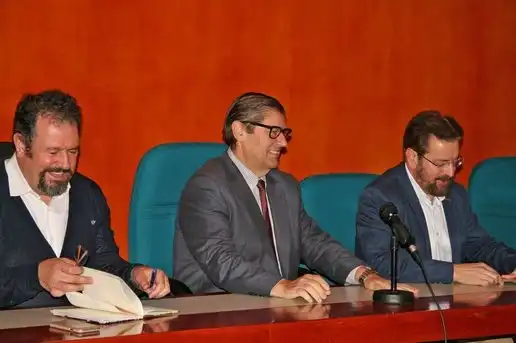
A Coruña, February 21, 2017.- Within the plan of visits that the Dean, Julio Abalde, is making to all the centers of the University of Coruña, last Tuesday he spent summer at the Faculty of Sociology together with the Vice-Dean of Scientific Policy, Research and Transfer, Salvador Naya.
The Dean began his intervention explaining the two challenges that UDC faces this year. On the one hand, academics, with a review of degrees and, on the other hand, linked to the previous one, with the identification of areas of relevance on the Coruña campus to achieve specialization. Not that two titles are under review, Abalde Lembrou who was the Socioloxía title, together with Occupational Therapy, the first to adapt to Grao’s new structure. “You are those who have more experience in this sense,” he acknowledges or reiterates to the teachers present, and this is a “good moment to review how the grades and the teachers are working, not only in singing but also in terms of teaching methodologies.” He reiterated that this work is the responsibility of the entire faculty of each center with the participation of administration and student services personnel.
On the other hand, the Dean indicated that at this time the strengthfs off the University of Coruña are being analyzed to identify those most powerful areas in which the Campus of Coruña can be a national and international reference. Just as it was done with the Ferrol Campus that specialized as an Industrial Campus, the aim is to find some lines of specialization that differentiate UDC from the nearest universities. “Without losing sight of the fact that we are a universal university with all areas of knowledge,” Abalde pointed out. The specialization of the Coruña Campus will also allow it to have additional financing to the established Financing Plan of the Galician University System in force as of 2020 and that, in the second year of operation, it will be seen that it does not respond as it should. The Dean explained that the improvement in the two indicators stipulated in PFSUG, which is becoming evident in the UDC, is not translating into any improvement in its financing. Other financing methods available to UDC, income via competitive projects, do not alleviate the expenses of the University because they are finalist income linked to specific projects. In the case of patronage, the Dean highlighted that it is still a minority contribution, UDC has important support from Inditex in programs such as InTalent to attract internationally renowned researchers.
The dean, Antón Álvarez Sousa, opened the list of interventions by pointing out that the review of degrees proposed by the Dean is a “very interesting topic, because in this faculty tensely debated a more generalist or more specialized degree is being made” as well as, Álvarez deceived, looking for a double degree with other universities. The Dean declared that, in his opinion, the generalist characteristic of the Degree in Sociology is correct and that specialization has to go without a master’s degree. The option of having a double title is “interesting” and is not considered a new degree in SUG because it would not require authorization from the Xunta. Some of the professors present pointed out the difficulties that researchers have in running their projects for European research calls due to the complexity of two processes and request a greater strengthening of the OTRI of UDC, which is still working very much and needs staff reinforcement. He also acknowledged the improvement in the management of the OTRI but stated that there is “a problem of scale” in our European projects. “We can praise OTRI but our structure does not allow us to look at the situation of the Catalan universities, for example, which have institutional support from the Generalitat in Brussels,” Abalde explained. The UDC has an office and a representative in Brussels but there should be a state support structure “to lobby and facilitate our work.” At this point the Vice-Dean of Scientific Policy, Research and Transfer pointed out a new open call from LaCaixa that is very interesting to which UDC researchers can join together and which is called “Impulse”.
Asked about the Teacher Statute, Abalde commented on the existence of a draft but that, in any case, in the UDC measures would be taken to reduce the negative impact that was being produced by the decree of teacher dedication. Regarding teaching stability, Abalde called it a “ballast” replacement tax but assured his commitment to “maintaining the teaching staff.”
Regarding the data of the Selectivity Access Tests for which the teachers were interested, it was indicated that this course will not be changed to a call from September to July, a modification historically demanded by universities to adapt the academic calendars in advance for the new students, but which is expected to be done next year.
Other interventions return de novo on the topic of the academic offer difference
Publicado por:
Gabinete de comunicación