


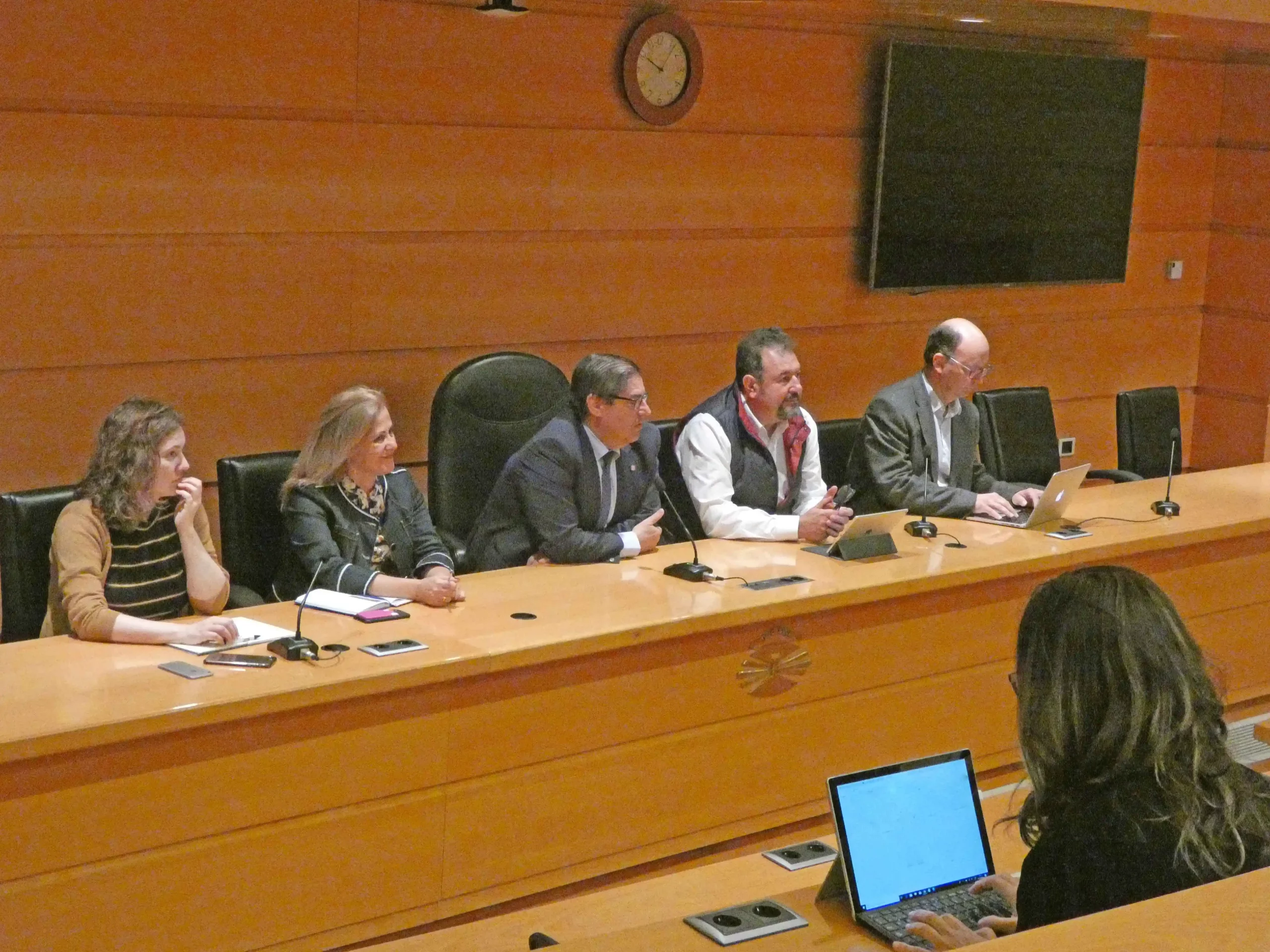
A Coruña, July 8, 2019.- The Rector of the University of A Coruña, Julio Abalde, as well as the Vice-Rector for Scientific Policy, Research and Transfer, Salvador Naya; the Vice-Rector for Internationalization and Cooperation, Pilar García de la Torre; the Vice-Rector for Students, Participation and University Extension, Margarita Amor, and the Vice-Rector for Teaching Staff and Teaching Planning, Alberto Valderruten, held a meeting with the UDC Department Directors, in a meeting organized by the Rector with the purpose of sharing impressions on current university news.
This meeting, held on June 7th and which is now customary to happen once throughout each academic year, complements the meetings that the Rector and his team hold with the university community of each of the centers, in which the projects of the Rectorate for the University are explained, so Abalde encouraged entering directly into the dialogue and speaking without preamble about the issues that concern the directors of the departments.
In this way, the director of the Department of Architectural Projects, Urbanism and Composition began, showing the concern that exists in this department about the announced new Law on Universities that goes deeper into the academic profile. “This is very worrying for us because we have a lot of teaching staff with a professional profile, in a career that has a high technical profile. The academic profile is important but much more so the professional background”, he explained, adding that the academic profile of the teaching staff with papers, doctorates, etc. “destroys our profession”. This concern is also shared by the Department of Civil Engineering, according to its director who assured that it also occurs in the areas of industrial and naval engineering; as was also highlighted by the Department of Navigation Sciences and Marine Engineering.
For the Rector, however, “it is a problem of balance”, linked to the figure of the associate professor. “A perfectly recognized figure; he is a professor of recognized prestige who comes temporarily to the university”. In the new Law there will be this associate profile because it is necessary, above all, in the areas of engineering but the university’s teaching and research staff must have “an academic profile with stable positions”. “The degrees must have a stable staff of professors with an academic profile, with scientific criteria, publications, that they can promote, etc.; and a part of professionals of recognized prestige who contribute, temporarily, their experience and complement the academic part”, Abalde opined. “I am a fervent defender of the associate professor but he has to be strictly associated, temporary, and who brings professional contributions to the university, they cannot fill an academic teaching position”, he defended, claiming that at the University of A Coruña what happens in others does not happen, since there is the figure of the interim replacement.
The director of the Department of Physiotherapy, Medicine and Biomedical Sciences agreed with this approach and asked to see this proposal for the new Law, to which the Rector replied that it is not yet public, and that only some details are known that are emerging. The document is being prepared by a working group of the Crue with the Ministry and, according to the Rector, it foresees that there will be several teaching figures, such as the teacher in training, the interim substitute teacher or the visiting professor, as well as a definition of the associate professor. The Vice-Rector for Teaching Staff indicated that it also includes a teaching dedication of all PDI figures with a doctorate of 240 hours, and of 320 hours. for figures who are not doctors.
The Mathematics Department confirmed that the calls for doctoral assistants are well organized for the promotion of teaching staff at the UDC but asked about the existing possibilities if an area is interested in bringing a teacher from another university. In deficit areas where there are no teachers and if there are teachers willing to come from outside, with accreditation, the entry option is an interim full-time replacement, the Rector claimed, explaining that a position cannot be created directly because “between everyone and the union centers we have given ourselves a way to manage the teaching staff”. “The entry of teaching staff at the UDC is an interim full-time replacement and we have to be rigorous there”, the Rector insisted and added that the new decree contemplates the creation of the visiting professor figure.
The Vice-Rector for Research also added that work is being done with the Xunta on talent retention and recruitment positions, in addition to the Beatriz Galindo route and the InTalent, which is the UDC’s own. The Rector took the opportunity to ask for reflection “when we want to open up channels for the incorporation of renowned professors from outside and we encounter misunderstanding from union representatives and some members of the Governing Council; when these positions do not interfere with the staffing of professors, nor with teaching, nor with promotion”. “If we want to strengthen and improve our research and teaching capacity with external people with important experience, we have to be able to promote the talent we have within and also open up a channel to recruit talent from outside and enrich the UDC”, he asked, adding that “we are achieving this” as demonstrated by the recent calls for positions as well as the promotions to full professors.
The director of the Department of Specific Didactics and Research and Diagnostic Methods in Education asked about the application of teaching discounts, since several teachers in his department are requesting them. The Rector explained that at the UDC, as in other universities, discounts are only applied when there is no need for teaching staff.
The Chemistry department wanted to know how the figures of pre-doctoral contract holders who become contract employees in training will be included in the new decree. Abalde acknowledged that this will be an organizational problem because they will not be responsible for teaching but will have to be with a professor in the classroom. The Vice-Rector for Teaching Staff was confident that the operation of pre-doctoral fellows can be maintained because they are not reducing POD hours. Valderruten also said that the CRUE is negotiating with the Ministries on the application of the rule that requires registration; as would be done at the university in the case of professors, whether registration is required if exams are taken home, if attendance at conferences is counted… At the meeting it was explained that it is taken for granted that there will be a control of teaching and attendance, but it remains to be seen how the research part is regulated. Who would control the research projects? The Rectorate? The principal investigator? In the case of projects, who would pay for the overtime? There are many questions that still have no answer.
Another issue that came up in the debate was the possibility of coordinating with other Galician universities the dates of registration, opening of courses, etc., as well as the evaluation of teaching staff from other university systems, such as the case of a project-hired person who is only evaluated for the teaching that the project allows and not for the teaching that he brings. In other systems, a project-hired person can teach, but in Galicia, he cannot.
The director of the Department of Humanities also wanted to talk about the recruitment of teaching staff, an essential competence of the departments, and showed her concern about the aging of the staff and “although work is being done on this, some of the actions that are taken are figures that do not allow the most appropriate selection to be made so that these additions can later become references in the area”. The recruitments are due to teaching needs, there is no assistant recruitment program that would allow hiring people at the beginning of their professional career who would have a career at the university, she regretted. She also put on the table the need to review regulations on recruitment scales. However, she said, the greatest concern in her department is the aging of the teaching staff, which was also agreed by Vice-Chancellor Valderruten. In recent years, the Vice-Chancellor explained, an analysis of the teaching staff was carried out to know the fixed picture of the areas and the degree of aging. “With this, we have incorporated this criterion into the calls for new positions and we hope that the Ministry’s proposal will include responses to this unanimous demand with regard to professional figures and their conditions.” The Rector pointed out the need to have a way that allows the university to objectively decide on the provision of teaching staff in areas with a greater aging process; that teaching needs are not the only criterion.
The director of the Psychology department asked about the criteria for associating InTalent and Beatriz Galindo to the areas of knowledge, to which Naya replied that the UDC proposes candidates who are at the top because they are evaluated by an external committee and that, in her opinion, the assignment to the area should be the decision of the person who comes to the position according to their research profile.
The director of the Health Sciences department asked in turn about the process of incorporating the School of Nursing into the University of A Coruña. “In the department, we are well informed by the Vice-Rector for Teaching Staff”, she continued, but wanted to know if there was anything new. The Rector assured that there was no change at the moment. “It is a degree that is taught in two centres and the conditions for its teaching in Ferrol will have to be the same as in A Coruña”, he added. The director of the Business department asked about the situation of Tourism, to which the Rector also replied that a response from the Xunta is awaited. “We said that we would try to arrive for the next academic year but the possibilities are getting smaller and smaller because the Xunta is not responding”, he said.
Finally, the director of the department of Physiotherapy, Medicine and Biomedical Sciences addressed the issue of the promotion of teaching staff which, she said, “pivots on the criteria of the Aneca, and says that universities stimulate research activities in emerging areas”. The University of A Coruña, explained the Rector, is making an effort to support research with its own funds (900,000 euros/year) based on the ANEP evaluation; regarding emerging areas, she claimed that nowadays the frontiers of knowledge are blurring and as an example she gave the case of a professor from New York, with a degree in Computer Science from the UDC, who researches cancer issues.
Finally, the vice-chancellor for Students, Participation and University Extension, Margarita Amor, encouraged department directors to apply for research initiation grants as well as collaboration grants in the departments of the Ministry.
Posted by:
UDC Communication Office