


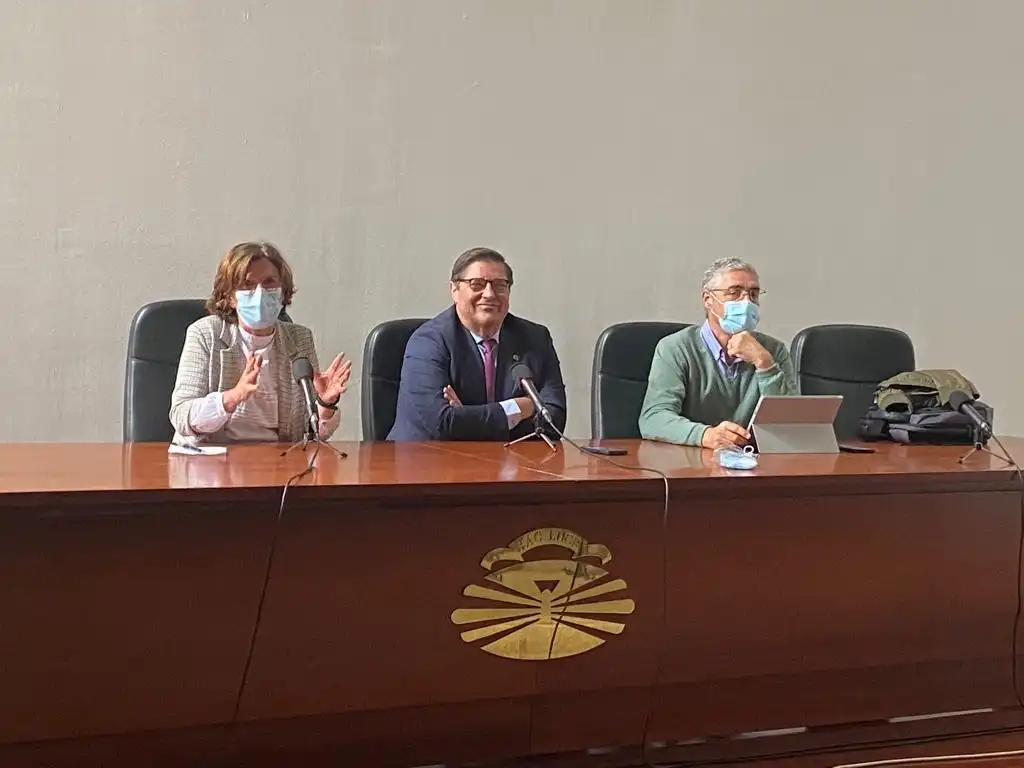
A Coruña, May 25, 2022.- Julio Abalde, Rector of the University of A Coruña, and Carlos Aymerich, Secretary General, held a meeting this Monday with the university community of the Faculty of Physiotherapy. These meetings aim to communicate relevant activities at the institutional level and receive opinions, suggestions or demands from each center.
The Rector began the meeting, open to faculty, students and administration and service staff, explaining how the pandemic was managed at the UDC and the prospects for the next academic year in which he hopes to recover normality. “It would be interesting to recover the usual schedules so that students can have university life, with interaction within the centers,” said Abalde. The new tools and IT platforms used in this time of pandemic will continue to be used as a complement to face-to-face teaching and, the Rector encouraged, the faculty will now have to decide what types of activities can be done virtually. For the Rector, there are teaching tasks that are easily adaptable to this online use, such as tutorials or the supervision of final degree and master’s theses, for example, or, obviously, to be able to continue in classes in cases of quarantine of faculty or students. The tools and new methodologies used in this time of pandemic will serve to better face the future in complex situations that may come.
The experience of these years, the Rector assessed, has been positive at the UDC. “Compliance with the protocols by the entire community has made the University a safe place; we have managed to ensure that there are no contagions at the UDC and we continue to maintain quality teaching,” he said, congratulating the attendees for their responsibility during the pandemic, in a center that is also complex in managing clinical practices for students in total safety.
The second point that the Rector addressed was the issue of the new Financing Plan for the Galician University System (PFSUG), of which the Xunta said that the increase was going to be 300 million euros but that in reality this increase is a forecast by the regional government on the amount that the universities themselves have to raise. However, the UDC makes a positive assessment of the PF, not in terms of the amounts but in its structure that responds to the demands of the University of A Coruña. In his speech, the Rector warned of the upcoming decline in university students due to the strong demographic decline in Galicia, when a few years ago 19,000 students took the university entrance exams, this year, only 11,000 students will do so.
Returning to the issue of financing, Abalde explained the existence of a new efficiency fund linked to the fulfillment of seven indicators such as not incurring a deficit, using analytical accounting or not exceeding the wage bill. At this point, the Rector detailed the cost of the staff, which amounts to 105 million euros annually, of the 109 that the UDC receives from the Xunta, with the peculiarity that this expenditure increases vegetatively, without an increase in staff, by two percent each year, so that in a few years the personnel expenditure will absorb the entire budget received from the regional government.
“This is why we must continue to be very rigorous in Chapter 1,” warned the Rector, but we will continue to maintain our programs for the stabilization and promotion of PAS and PDI.
The last aspect that the Rector discussed before giving way to the open round of interventions was related to the financing plan. At the moment, the UDC is preparing the Strategic Plan with a temporary validity coinciding with the financing plan. A total of five committees made up of more than a hundred people are preparing a document of the university that they want to have by the year 2026. Abalde encouraged everyone present to collaborate and participate in defining the UDC of the future. The forecast is that before the summer they will have the first document that will be submitted to the public exhibition and that will be taken to the Senate for approval in September.
During the presentation, one of the professors asked about the status of the project to create the University Clinic and how it will be affected by the current budget situation. The Rector assured that “although it will have a cost for the UDC, we assume that it is valuable for the students. The benefits will be greater than the economic cost”. At this point, the dean, Luz González Doníz, clarified that the creation of the Clinic is a historical demand of this center in which they are working with some health institution to carry it out. The Clinic “will facilitate teaching and will have a research niche, we will make a significant leap in research”, the dean advanced.
The talk also addressed the situation of research contracts and the different existing programs, as well as the possibilities of stabilization. The Rector explained that there is a program of the Xunta that is difficult to continue because the autonomous community itself does not facilitate it. The University has repeatedly and unsuccessfully demanded that this issue be resolved and allow these researchers to access programs for attracting excellent science such as the Beatriz Galindo, Ramón y Cajal, Marie Curie or the UDC’s own InTalent.
The issue of the Uadi and its integration into the Uxai was also discussed in this meeting. The Uadi headquarters is within the Administration, with the same functions, this academic year the situation is the same as before but the administration will be the one to direct the administrative work, which is “good”, the Rector said, because if there is an excess of work in one position, another one with a lower workload can help. “We must avoid one-person actions because if for any reason that person is missing, it paralyzes the administrative process”, declared Abalde.
He also asked about the new structure of the Technical Quality Unit and its implementation. The UTC will assume all the support functions for the centers and degrees and the forecast, the Rector pointed out, is that it will be operational in September, after the completion of the transfer competition.
The dean expressed her satisfaction with the recovery of complete normality for the next academic year, after this one had recovered considerably but “we see that the students’ habits of coexistence have been lost”, she said, assuring that “we are all making an effort to restore academic life”. González Doníz commented on an aspect of postgraduate training that concerns them at the Faculty and on which she asked for reflection so that the Strategic Plan includes flexibility actions for the hiring of external teaching staff. The Rector pointed out that the degrees must have a stable teaching staff base but then the teaching can be complemented with prestigious professionals in a format of seminars, conferences, etc., as is already being done in some undergraduate and master’s degrees.
Finally, the meeting discussed the situation of the building, which is in need of improvement works. The UDC is responding to all calls from the Xunta that allow for works to be carried out in the centres and this building is one of the priorities, according to the Rector. The dean stated that the existing spaces are limited and there is not much room to grow but pointed out the possible availability of the church building on the campus, which has been deconsecrated, but is owned by Sergas, as well as the closure of the premises, which is in need of urgent repairs, but which belongs to the Health Department.
The Rector closed the meeting by thanking the members of the Faculty of Physiotherapy for the response given in times of pandemic, which he extended to the university community. The UDC stood out above the rest of the universities in the support and accompaniment provided to the teaching staff, students and administrative and service staff, “credit to all but if any service was more involved it was Cufie and the IT Services”. Within the Spanish University System, the UDC is at the highest level in terms of the best response to the pandemic.
Posted by:
UDC Communication Office