


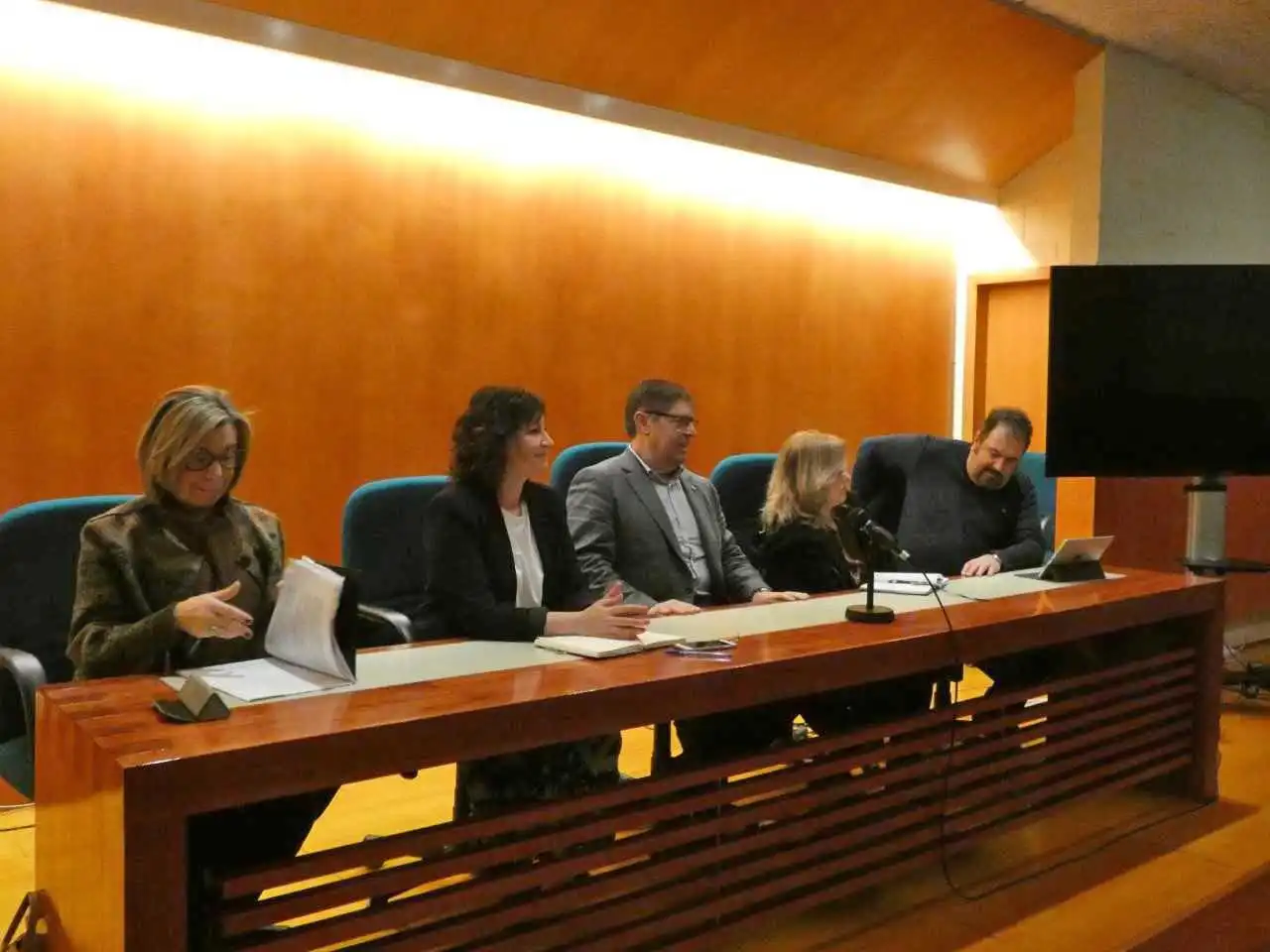
A Coruña, March 1, 2019.- The Rector of the University of A Coruña, Julio Abalde, met on February 18 with the university community – teaching staff, administration and services staff and students – of the Faculty of Sociology, together with the Vice-Rector of the Ferrol Campus and Social Responsibility, Araceli Torres, the Vice-Rector of Internationalization and Cooperation, Pilar García de la Torre, and the Vice-Rector of Scientific Policy, Research and Transfer, Salvador Naya.
The meeting, which is a regular meeting of the Rector and his team every academic year in all the centers, aims to explain the projects that are being developed from the Rectorate and listen to the peculiarities of each of the faculties. Abalde began by recalling the three strategic lines on which work was being done: teaching, research and internationalization. With regard to teaching, the objective is to update and complete the teaching offer with new titles; the improvement in terms of research and transfer involves giving greater support to research groups so that they can participate in European calls and open themselves up more to society and business. In a cross-cutting way, internationalization was addressed with the incorporation of more foreign students, not only for mobility of one semester but also for them to complete the entire degree or master’s degree at the UDC, although incorporation into the degree has special difficulties due to access to the university.
These three axes were integrated into the specialization project of the campuses, from which the Industrial Campus of Ferrol and the Sustainability Campus and the Innova Campus, in A Coruña, emerged. All these processes are being developed and the first results were the implementation, this year, of the new degrees: Degree in Fashion Industrial Management, the first multilingual in Galicia in English; and the Degree in Landscape, with the USC, the first interuniversity in Galicia. Next year, it is expected that the Degree in Data Science and Engineering, Degree in Digital Creation, Animation and Video Games, Degree in Digital Information and Documentation and Dual Degree in Electrical Engineering, the first dual in the Galician University System, will begin.
The specialization campuses have two aspects, the Rector continued to explain, on the one hand, coordinating this entire new structure, creating synergies and supporting related activities and, on the other, obtaining structural funding for the UDC, since the funding obtained for research is finalist funding.
Healthy menus
The Dean of Sociology, Raquel Martínez, then opened the debate but first wanted to provide the Abalde government team with background on some of the projects that the faculty is carrying out in harmony with the specialization campuses, both the Sustainability and the Innova campuses, as well as the UDC Green Campus program to promote the quality of life of staff and students. In this regard, a change was made to the vending machines that will have healthy products, as well as the incorporation of a dietitian in the UDC to make the dining room menus healthier, with 60% healthy food. The Dean also advanced other measures to improve the faculty such as the reformulation of the tutorial action plan with the involvement of students, as well as the Final Degree Project in which they introduced an Extraordinary Award. Martínez advanced a plan to promote internships in foreign companies for which they are already establishing the appropriate contacts. The Rector congratulated the dean’s team and the entire faculty for these initiatives. For her part, the Vice-Chancellor for Internationalization pointed out that there are several programs to promote internships in foreign companies that may be of interest in this process of internationalization of Sociology, both for curricular and extracurricular internships. She even explained the possibility of bringing a professional from a foreign company to teach classes at the UDC, which constitutes a very interesting vision of the business sector.
One of the professors present praised the work being carried out by the OTRI because “we researchers notice more support”, a congratulation to which the Rector joined, adding that as a result of their good work, together with that of the researchers, the year 2018 was a record year in the number of applications for European projects and in the acquisition of European research resources.
The Vice-Chancellor for Research announced that the UDC will soon sign a new Chair with a local company that will focus on issues of responsible consumption and healthy living. The dean assured that the creation of this Chair would be “very good news for this faculty”.
InTalent
Among the attendees was InTalent researcher José Antonio Cortés, one of the first researchers to take advantage of the talent recruitment program launched by the University of A Coruña and the company Inditex. The Vice-Rector for Research took the opportunity to inform the attendees of his and Cortés’ presence at an academic meeting in Lisbon where the InTalent program was presented, making a very good impression.
Another of the topics discussed was that of the teaching staff. This faculty, with the latest additions, has a rejuvenated faculty that has a worrying face in the department, according to a teacher. In recent years, a third of its teaching staff has retired in the Sociology area, she said, replaced by teachers who have made it so that where there were professors, there are now temporary replacements. This teacher demanded the incorporation of other higher-level figures, but the Rector explained that the union centers do not contemplate this access system.
Abalde spoke about the decision that, as a government team, they have regarding the teaching policy, which is to take out temporary full-time replacement positions and then stabilize them. The replacement rate limits the action, but the UDC has the priority of maintaining its staffing plan, first with the stabilization of teaching and then with the promotion. The dean pointed out the possibility of revising the scale of the research part for the selection of teaching staff but as the current regulations are, it is difficult to fit.
Posted by:
UDC Communication Office