


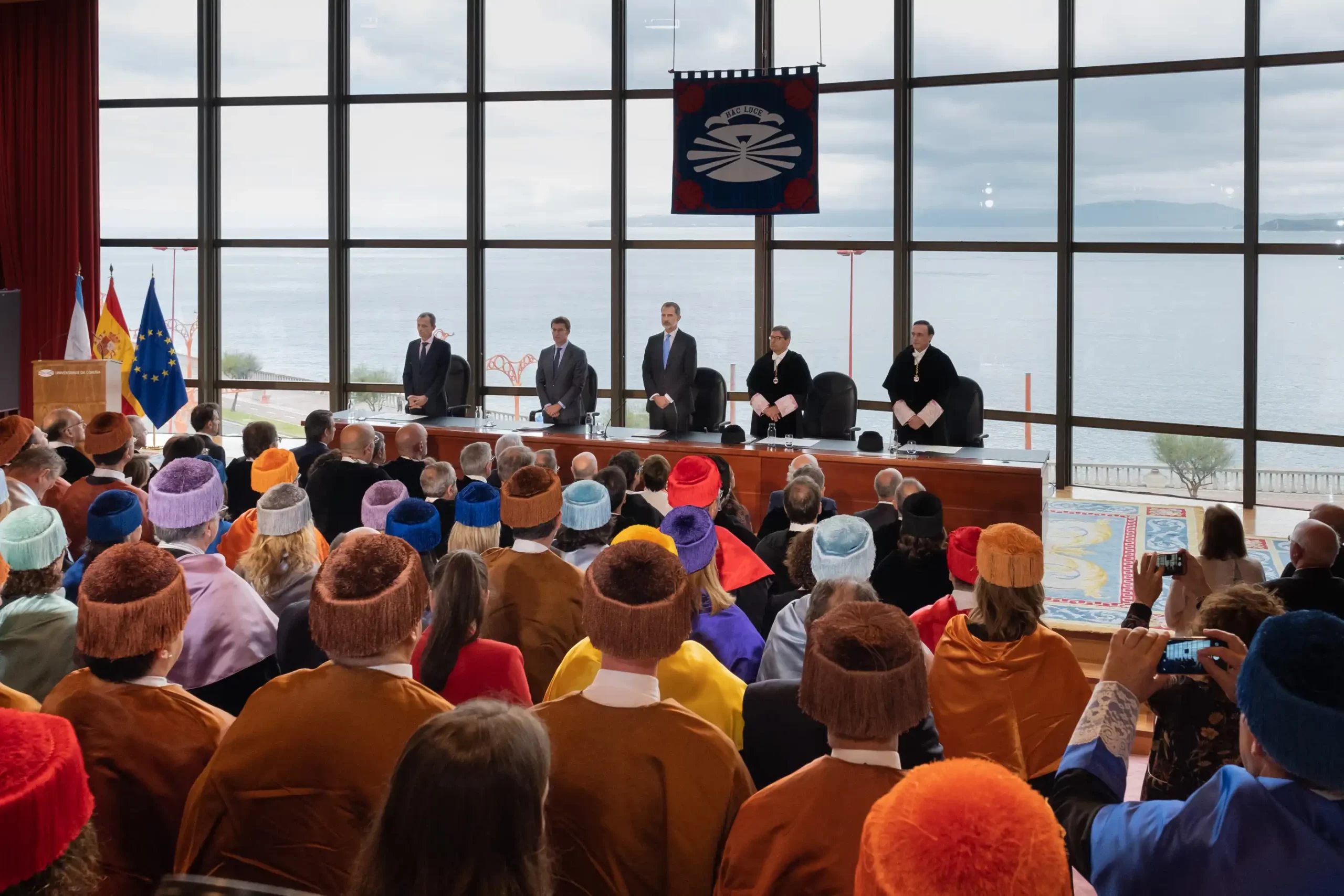
Course opening of the Spanish University System
Speeches
Speech of His Majesty the King at the opening of the 2019/2020 University Course
“For me, it is a pride and always a great honor to preside over the official opening of the university course for all of Spain every year. And on this occasion I am very happy to do it in a land like Galicia, for which we feel so much affection, and in a university as young and modern as the University of A Coruña that welcomes us today.
There is no doubt that our university system, formed over 40 years of democracy, has contributed decisively to the articulation of our society and has been crucial so that during these years equality of opportunity between citizens and the contribution of knowledge to our development have grown very remarkably. And it is crucial and unquestionable that our universities, as the vanguard of society and a constant bet on the future, continue to play that role.
Thus, the pillars of our university are solid. Spain is among the 10 countries with the highest scientific productivity in the world ─ most of it arises from the university environment─ and has built a cohesive higher education system that allows for high quality training throughout our country. It is a reality that Spanish universities produce very well-prepared professionals, like those of the rest of the most advanced countries.
Although during the years of crisis the activity of the University was greatly affected, certainly the entire university system was able to maintain its functioning thanks to the commitment and effort of its staff: professors, researchers and other workers who have made it possible to preserve university quality. Undoubtedly, this effort has made it possible for the Spanish university system to also maintain a relevant position in the international arena.
However, the challenges facing Spain in the coming years in the context of higher education are not few. I am referring to issues such as the improvement of the job insertion of new graduates, the modernization of the curriculum of their studies, greater internationalization, or the recruitment of people with research talent who have developed part of their professional career abroad. I am also referring to the new ways of transferring knowledge, the promotion of scientific vocations and the educational challenges of the first magnitude associated with the digitization and robotization processes at work.
Collectively we must be aware that technology and intelligent automation will take over more and more aspects of the skilled professions, and that this will happen at a breakneck pace. The way in which these phenomena will impact the labor and social world will be a reality that we will have to face as a society in the coming years; also, naturally, from the University. Faced with this approaching scenario, educational institutions must be prepared to meet the imminent technological transformation.
Therefore, it is necessary to consider as soon as possible the best way to prepare our young people for the new digital jobs, many of them still to be defined, and which educational solutions are the best for increasingly complex scenarios.
It is, without a doubt, a complex challenge. The University must also guarantee that the student community as a whole receives sufficient training with which to evaluate the risks, expectations and opportunities of the future, so that technical developments can be oriented to the benefit of society as a whole. Finally, this must be done without damaging the transmission bridges of our entire cultural heritage and the humanistic knowledge that defines us.
It will therefore be necessary to strengthen studies in technology and computing ─ because, in a certain way, being competent in these disciplines will be the modern equivalent of knowing how to read and write from past centuries─; but without forgetting that the most pressing problems posed to us today by scientific-technological development refer us to questions that must necessarily take humanistic concepts and knowledge into account. University systems in the 21st century must therefore combine a double function: play a fundamental role in the new economy and, simultaneously, rigorously claim their critical spirit as part of their social commitment.
Currently, many voices are warning of a crisis in the very idea of a university. The challenge lies in adapting an institution with so many centuries of history so that it remains central today and tomorrow, even under the pace of the accelerated changes of our time. The very expression “Universitas” – as every university student knows – alludes to the universality of knowledge and was also, from its origin, the term with which the guild was named to protect the interests of people committed to “the profession of knowledge”.
Therefore, I am convinced that the University will maintain a relevant role in future societies, preserving that germinal character, that of an institution that favors spaces of encounter with knowledge, not only for all members of the academic community but for the whole of society in general; spaces from where to be able to innovate and also reflect, from where to measure and guide many of our advances, and also, when necessary, from where to receive alerts about the risks that we have to face with greater rigor and certainty.
Ladies and gentlemen,
At the end of the 19th century, the Free Teaching Institution set out with a catalog of principles to which it proposed to be faithful. Specifically, education would have to facilitate a professional training that would prepare students to be scientists, lawyers, doctors, engineers, writers…, but, as his educational program of 1876 said, “about that, and before all that, people capable of conceiving an ideal, of governing with substance their own life and of producing it through the harmonious consortium of all their faculties”.
This spirit, this ideal, must accompany any educational modernization process. Prepare specialists and professionals of the highest quality, without ever neglecting the need and the objective that students can intellectually and vitally experience their own training.
Because an unrelinquished objective for the University must continue to be that of educating educated citizens with the ability to judge; people committed to the future of their community, of their society, attentive to novelty and knowledge; men and women, in short, who contribute to sustaining a democratic society, self-critical and open to a globalized, interdependent and interconnected world.
Thank you very much.
Speech by the Rector of the University of A Coruña, Julio Abalde Alonso
“The University of Coruña has the honor of hosting the solemn opening ceremony of the 2019-2020 academic year of the Spanish university system.
We are pleased that this first visit of the head of state to our university coincides with our thirtieth anniversary and to have the company of authorities, representatives of entities and institutions and the top managers of a good number of Spanish campuses.
Allow me, first of all, to congratulate Professor Amparo Alonso, professor of the Faculty of Informatics and president of the Spanish Association of Artificial Intelligence, for the magnificent lesson with which she opened this event. Thank you very much, Amparo.
—
The University of A Coruña belongs to the generation of Spanish public campuses born under the University Reform Law of 1983.
We are one of those public universities that in the last three decades have contributed to facilitating the exercise of the right to higher education, with all that that implies for raising the cultural and professional level, for social cohesion and equity and, ultimately, for the social, economic and cultural progress of Spain.
In the centers of A Coruña and Ferrol, more than 2,200 people work (of which 1,400 are teaching and research staff) and more than 19,000 students study. The sap of our classrooms is renewed every year with the arrival of more than four thousand young people.
With the birth of the University of A Coruña, a new center for the cultivation and dissemination of knowledge and scientific research was established in the north of Galicia and Spain. A strategic engine for local and regional development, also strategic for innovation in collaboration with public administrations and companies.
Throughout these 30 years we have grown and consolidated our academic offer and our scientific capacity and we have multiplied the transfer of results to our socio-economic environment.
We have faced the changes and the demands of the new times as opportunities to outline our identity and take relevant steps forward in the improvement and internationalization of our campuses.
—
The central role of universities is expected to increase progressively in the coming years. The strategic positioning of Spanish universities will be more decisive and necessary every day in a world that is also increasingly globalized and immersed in a progressive change in the economic model.
Spanish universities are in a position to face these changes, we have a good university system. Good campuses, from which well-prepared students emerge. Good campuses, which are the country’s main scientific research centers.
Let’s remember that, despite how misleading the comparisons can be, despite the marked differences in funding, the three most prestigious international rankings place more than half of the Spanish universities and 84% of the public universities among the 1,000 best in the world.
But we need to thoroughly review the legal framework. We need new state legislation that guarantees stable and sufficient funding. A new regulation to provide universities with the necessary autonomy for the performance of their academic and scientific functions and their reinforced role in the Spanish R&D system, without the bureaucratic corsets that undermine their competitiveness and efficiency.
It is urgent that we equip ourselves with the appropriate legal instruments and financial resources to avoid the flight of talent and be able to attract it. We are happy (and grateful) to be able to count on the collaboration of private companies in programs such as Intalent at the University of A Coruña to recover and attract research talent, but we need autonomy and support from public administrations to develop more recruitment programs.
We are living in an era of deep social and economic changes, generated at a dizzying pace by such determining factors as the spectacular technological advances that surprise us almost every day.
Adaptation to change has become one of the greatest individual and collective strengths in universities, forced like no one else to rigorously read new processes and new challenges without falling into the traps of fads and short-term or short-term initiatives.
Our missions are clear to us, as well as our present and future commitment to the renewed agenda that the European Union promotes in universities, as well as the Sustainable Development Goals of the UN Agenda 2030.
But it is easy to see that the Spanish universities face the new decade in manifestly inferior conditions.
The adjustments and cuts applied during the crisis have left us with 10,000 million less funding. Such a loss affects our structural funding very seriously and weighs down the enormous potential of our campuses.
It is now up to us to face the recovery of the lost ground. It is time to establish a sufficient budgetary framework and at the height of the character, which we affirm, is strategic of our academic and scientific function.
Europe had set itself the goal of achieving an investment of 3% of GDP in R+D+i for the decade that is coming to an end. In Spain, with 1.20%, we are far from the goal. If we affirm that investment in higher education and R&D is the basis of the present and future competitiveness of the Spanish economy, we must act accordingly. This is how society and public authorities should understand it.
—
Thousands of students have joined the classrooms these days in the faculties and schools of our campuses.
At the beginning of the course we must renew our commitment to our students: the responsibility to offer them a quality education and the commitment to the constant search for excellence that characterizes good universities, that defines good university students. It doesn’t hurt to remember it.
Commitment that goes into advancing our internationalization process; for permanently updating learning methodologies and instruments; for expanding the connection with the professional environment through internships; for guaranteeing scholarships and aid so that equal opportunities are effective; for offering, in short, a study and work environment that meets the needs, enthusiasm and expectations of students.
—
The 2019-2020 academic year begins and I wish all university communities a good academic year.
Many aspects of our obligations to society, which we like to define as strategic (because, certainly, they are) go far beyond objective indicators, figures, credits and budget items.
The fact that the technological paradigm determines the centrality of universities in the engine room of 21st century society must reinforce our obligation to provide students with a solid foundation of intellectual training, in addition to professional training.
Society looks to us as references, not only academics and scientists, but also humanistic, social and cultural values, which must permeate our daily work.
The values inherent in an open and advanced society, such as the commitment to sustainable development, social cohesion, equal opportunities, integration or against gender violence and any type of discrimination.
Values, likewise, such as the promotion of our culture and our language, the old Galician language with which I end this speech. The official language of the University of A Coruña that defines our personality and our character, that opens us to the world and that links Galicia and Spain with a broad cultural community beyond our borders.
Thank you to everyone for sharing this special day with us today, in our Auditorium, for the University of A Coruña.
Thank you very much.”
Speech by the president of the Xunta de Galicia, Alberto Núñez Feijóo
“We are at the gates of a new decade. We are at the university which is a beacon to contemplate that immediate horizon.
The motto of the university headquarters where we are now mentions precisely the light that serves as a reference, marks the route and dispels the darkness.
Just as navigators have had for centuries the lighting of the nearby Tower of Hercules, so too the University as a whole has a mission of guidance and inspiration that is especially necessary in these times.
In the face of the approaching new decade, there are two antagonistic attitudes that correspond to two disparate political, social and economic philosophies. One is summed up in the question of “what is going to happen”, in other words, what awaits us in a destiny that we could not govern or much less alter.
Such a position involves attitudes bordering on the apocalyptic because in that future in which we would only be passive subjects, there are usually no reassuring elements.
But that question that presents the future as if it were an inexorable climatological circumstance, has its counterpoint in a very different question. The question is not “what is going to happen”, but “what are we going to do”. The answer is in society, in the institutions, but especially the answer must be here in the University. It is here where the future is anticipated, shaped and ceases to be a threat to become an opportunity.
Not only because it is in the classrooms and study centers where the professionals of tomorrow acquire knowledge, but also because knowledge, debate and reflection are bubbling in the university community.
The University has almost always been like the tireless explorer and discoverer of territories that seemed forbidden by ignorance, obscurantism and superstition.
More than 500 years have passed since Lope Gómez de Marzoa founded one of the oldest universities in the world, that of Santiago de Compostela, and since then that anticipatory faculty remains.
That is why this is an ideal place to reflect on the coming decade, especially on two aspects that worry those of us who share democratic ideals: social fragmentation and the consideration of the truth as something annoying or in any case dispensable.
The etymological root of “university” refers us to the idea of community. “Ayuntamiento”, it is called in his Partidas Alfonso X the Wise, the same one who had Galician as the language of culture.
The university tends to the objective of a collective mind capable of facing the challenges of knowledge and its transmission.
We can find a similar impulse in democracy, in the development of great nations like Spain, in the birth of structures like the European Union, or in the genesis of international cooperation organizations.
However, there are currently several factors that question the desire to find the “common” that unites people and peoples, to replace it with the search for elements of division and fragmentation.
Here is a dilemma that will undoubtedly be present in the next decade and that gives the University a very relevant role as a link of union or as a “Parliament” of knowledge.
I use the analogy between University and Parliament because both express the very human desire to cooperate to open new paths in understanding. It is no coincidence that both are the favorite destination of criticism from those who advocate for rarefiing the coexistence between peoples and people.
Another challenge present in our days and which will perhaps become more acute in the decade that awaits us, affects the truth. If in past eras the enemy of freedom was the truth understood as something unique, immutable and dictated, in the times we have to live in the danger comes from those who take it for dead.
We see in the University a decisive vanguard in the defense of the principle that there is no single truth as before, nor a post-truth as some want to establish now, but truths that evolve, dialogue with each other and offer stable answers to coexistence and knowledge. Without shared truths that knowledge becomes difficult, and democracy itself becomes more fragile and remains at the mercy of its adversaries.
Your Majesty, ladies and gentlemen. We would like the next decade to be a “decade of lights” for the world, and in that purpose the University has a leading role, as it has in the moments of our history that were illuminated by freedom and progress.
We Galicians know this especially since our freedoms have always been sheltered in our University, when what Celso Emilio Ferreiro described as the “long stone night” reigned outside its walls.
The University has been and is a fundamental part of Galicia. It is because it reflects that desire to unite that is typical of our people.
Recently, during a trip to the Argentine Republic, I remembered how our emigration baptized its civic entities. Terms such as “grouping”, “brotherhood”, “meeting” or “community” are frequent and attest to the culmination of a long road that begins in the isolated forts and has its goal in this familiar, Spanish and European Galicia.
That is why Galicia has made the University, during these years of democracy and self-government, one of the most precious jewels, and in correspondence our three universities have been an example of institutional cooperation, adaptation and service to the community.
Galicia has been able to create a university system made up of three universities that are increasingly acting in harmony, which is related to what we said before about the fight against fragmentation.
Diversity does not fragment. The defense of inclusive identities does not lead to isolation or mistrust, as demonstrated by the universities and the Galician community itself in its relationship with the other peoples of Spain and Europe. They are ours, universities that add up. It is Galicia, a town that grows by adding wills.
There is also in that symbiosis of Galicia with its University a European factor that I must highlight in an act like this. Next to the Camino de Santiago, there is another almost as old, intellectual and non-orographic, traced by the relationships between university students and European universities.
For example, in the epistolary relationship maintained by our Alonso de Fonseca and Erasmo de Rotterdam there is a germ of the European that is combined with the transfer of pilgrims going to Compostela. European Galicia arises from both paths, which are perpetuated at this point in the 21st century and will have a new climax in the Holy Year of 2021, within that already imminent decade.
Your Majesty, ladies and gentlemen. A long time ago, on the occasion of the inauguration of the university course in Salamanca, Miguel de Unamuno directed those who scolded him with words that have not lost their validity to differentiate democracy from the various forms of authoritarianism.
“You will win but you will not convince”, said the writer. In democracy, you win in the elections, but the essential thing is to convince through reason, that university tool par excellence.
We Spaniards have been practicing this “democracy of conviction” for several decades in which political defeats and victories are always reversible and provisional.
We can well affirm that the university spirit based on convincing is transferred to the whole nation to build among all a democracy that, without false modesty, can be described as exemplary and in which the Crown has a synthesis function.
It is synthesized between eras, between ways of thinking, between territories and cultures. The parliamentary Monarchy represented yesterday by Don Juan Carlos I and today by Don Felipe VI, unites us around shared truths.
From his hand, and counting on the University converted into a lighthouse, the new decade, the decade of our Jacobean, the “decade of Enlightenment” is seen full of hope.
Thank you very much.”
Speech by the Minister of Science, Innovation and Universities, Pedro Duque
It is a pleasure to be here today, at the opening of the academic year of the Spanish universities.
Your Majesty, I want to thank you for your presence in this solemn opening ceremony of the 2019-2020 academic year. We are honored by the deep commitment of the Royal House to the mission of the Spanish University, to contribute to the progress of society through the transmission of knowledge accessible to all, research and the transfer of knowledge. These crucial areas for the present and the future of the country are those that belong to the Ministry that I am honored to lead, areas that face enormous challenges, as has been clear in the presentations that have preceded me.
Rector, it is very satisfying that we are celebrating the start of the academic year at the University of A Coruña, celebrating the thirtieth anniversary of a young institution that houses almost 20,000 students and that has been fundamental to the development of an innovative and thriving region.
I join in congratulating Professor Amparo Alonso, who works in a strategic field, “new electricity”, which is not only a priority for the Ministry of Science, Innovation and Universities, but for the entire Government. We have a firm commitment to encourage and support research and favor the existence of environments for its development, but we also have the obligation to ensure that these advances occur in conditions that guarantee shared benefit, preserve civil rights and democratic values, and anticipate the effects posed by the rapid introduction of Artificial Intelligence in basic social areas. These are the essential elements of the National Artificial Intelligence Strategy we are working on and which will be made public before the end of the year.
Picking up the gauntlet of the rectors who have preceded me in the floor, I would also like to underline the enormous dynamism and quality of Spanish universities. Despite their structural problems and the enormous difficulties experienced during the long years of crisis, they have been able to maintain and even improve their capacities and results, as shown by the data that they have already presented to us in their interventions.
Although it has already been mentioned, I would like to highlight the role of Spanish universities in the “European Universities” program, the new framework of alliances between campuses that will allow the mobility of students, researchers and professors, and which goes beyond the Erasmus program. It is a clear bet for the competitiveness of our universities, and it is a matter of pride that eleven Spanish universities have been selected so far to participate in the 17 European campuses, three of which also act as coordinators of their respective alliances. Last week I went to Brussels for the Education Summit and it became clear that Spain is one of the countries that has had the most success in this program, something that is a merit of the universities and that shows their quality.
As a European country, we will continue to support this program, as we will also continue to work to improve our university system, as recommended in the report on Education presented during the Summit. We are all aware, as we have heard today, of the need to modernize some key aspects of the Spanish university system. With more reason if we want universities to be central actors in the new economy and to remain essential institutions in the new socio-technological environments that are anticipated.
This requires that, as a society, we consider which reforms are essential to achieve more autonomous, more competitive and more responsible universities with the societies in which they are inserted. Reforms that allow them to be more innovative, more contemporary, more committed and with more capacity to face the new demands demanded by society.
Rethinking how we want our academic institutions to be is one of the Ministry’s priorities. The time has come for the university system to have a new regulatory framework, a new University Law that guarantees the necessary flexibility so that they can develop their own strategic models, build environments for the generation of talent and develop in an increasingly competitive global framework. This new University Law will have to propose reforms that solve chronic deficits of the Spanish university system, such as addressing a new framework of institutional governance, promoting internationalization, enabling mechanisms that allow attracting both young researchers and established scientists, or favoring the role of universities as drivers of regional economies and their productive tissues.
There are two areas that I would like to highlight because I consider them essential. On the one hand, the adaptation of training to the new labor reality. According to data from our own Ministry, the labor insertion of Spanish university graduates is much higher and more positive compared to the population as a whole without higher education, but it shows important mismatches. While the group of university graduates has higher employment rates and almost half the unemployment rate than non-graduates, the levels of overqualification are very high compared to the European average. This reality requires us, as public representatives, to help universities modernize and adapt training to the needs of future employment.
On the other hand, it is essential to preserve the character of equity and ensure that knowledge and higher education are considered common goods. In terms of teaching, the university not only fulfills a formative function, but must maintain an educational commitment. As a generator of knowledge, it must understand what the real challenges and challenges of advanced societies are, and continuously push the frontier of knowledge in that direction. As a social institution, it must disseminate and share results and knowledge, encouraging the meeting with other social actors, and constitute an instrument of justice in the distribution of opportunities.
Majesty,
We are not living in easy times, neither for universities nor for society as a whole. But in the Ministry of Science, Innovation and Universities we continue to work day by day to improve the efficiency in the use of resources and to promote their continued increase. The Government is firmly committed to the modernization of Spain and a productive system based on knowledge and innovation, to which the Universities contribute decisively.
I know that I count on your support and that of everyone in this room to achieve the objectives that I have presented to you, objectives that will lead us to have a more formed, fair, supportive and free society.
More creative and innovative, and therefore more prosperous.
Thank you very much.
Speech by the president of Crue Spanish Universities, José Carlos Gómez Villamandos
“In these minutes when His Majesty allows me to address the attendees on behalf of the rectors and rectors, for which I sincerely thank you, I want to begin by congratulating those responsible for this brilliant event, especially Rector Abalde, who I know has taken care of every detail so that we all feel at home and that this event has the solemnity that the opening of the university course by His Majesty the King deserves. Thank you, dear Julio. And thank you very much to the people who make up the University of A Coruña for the brilliant work you do in your service to society.
You are a clear example of the extraordinary value of our University System, which I am obliged to remember, in an exercise of responsibility, is conditioned by the stagnation of the solutions with which we must face the day to day and the future in the medium and long term.
The closer we get to the nature of the problem, the more we find positions entrenched in party interests or ideological postulates that prevent us from moving forward in the search for the solutions we need. They only have to analyze the numerous statements, biased studies, when not striking headlines, that only study the variables of interest to obtain a predetermined result. It is easy to see that there are those who are more dedicated to looking for weaknesses or faults, than to solving structural problems that anchor our country and do not let it take off as it should in the future.
We live in a time when opinion predominates over information and reality, based on ill-founded topics, when not directly intended. With statements that seek to undermine the reputation of the university, especially the public university. To make those statements is to call into question the training of our doctors, lawyers, engineers, architects, nurses… thousands of graduates who practice with more than proven professionalism and qualifications, being key elements in the development of our country. Making those claims is tremendously irresponsible.
Despite everything and thanks to the effort, never sufficiently recognized, of all levels of the university community, Spain has a solid and consolidated University System, which is an international reference in many areas of knowledge. We are the second country in the world with more universities within 5% of university excellence per million inhabitants. We are the eleventh powerhouse in quality scientific production. We are the seventh country in university efficiency and effectiveness; with 38 universities in the top 1000 of the Shanghai ranking; and 45 in THE ranking. And the result of the call for European Universities has been a success.
All this in the context of being the thirteenth economic power in the world, with economic indicators lower than those of universities and having only 7 companies in the top 1000 of the world ranking of innovative companies. All this despite the fact that we have a budget per student that is a fifth of that of EU universities, and with the investment in R&D considerably reduced, unlike the growth experienced in the countries around us.
Look, reality, despite everything, is stubborn. Society, the citizens of the territory of influence of each university are really proud of it, they feel it as something of their own, there is a sense of belonging, even if they have never set foot in its classrooms, because its creation has been the achievement of society, something that can be seen in the celebrations of its birthdays. The effort of generations has made it possible to create, maintain and improve our universities, depositories of the illusions of our young people and generators of their hopes; universities that belong to everyone and for everyone.
Universities have shaped our territory, they have generated equal opportunities and equity; they have been, and are, one of the main economic drivers of our provinces, returning €4.3 to society for every euro received. And most importantly, they have been an irreplaceable social elevator, fulfilling the personal and professional aspirations of many families.
This social elevator is in danger as a result of lower public investment, an ankylosed labor market and economic structure, widening the social gap and generating populist approaches. A labor market that forces our young people to seek employment abroad, where their training and qualifications are, look where, valued and recognized. Just as it is recognized by employers in Spain, as shown by the results of the surveys that the universities do about our graduates or students on external internships.
What it does, what university education should do in a European context, is to provide our students with the fundamental knowledge necessary for the performance of their profession, and which, along with facilitating a better cognitive structure, gives them the versatility, the hallmark of a university student, to adapt to a changing world, where they will be able to respond to today’s challenges, as they already do, and to the challenges of the future that today we don’t even suspect; we are talking about a university that improves the capacity for individual and collective thinking, the basis of creativity and innovation. This is how we must prepare for the future, this is how we have done it and this is the only way to explain the development of society.
Because the University trains on a professional level and also on a personal level. University values have been essential to grow as a country and the economic and social miracle that Spain has experienced cannot be understood without the contribution of the University. But this success, which you are, does not make us fall into complacency. Many things have been done well, and in others we undoubtedly need to improve.
We are a University in continuous change and improvement process. I don’t know a university community that is not competitive and demands from its government team measures to improve. I don’t know a chancellor who doesn’t want to improve teaching, research, the transfer of their university or the employability of their graduates; who does not want his university to be a benchmark and driver of culture and democratic principles and values”. In a situation of economic crisis, our universities have been able to improve their capacities and results despite experiencing moments of great uncertainty and difficulty in financing that have highlighted the need for structural reforms that we have been demanding from Crue Universidades Españolas.
A Law that we want to be the result of consensus, that responds to specific objectives, with general lines agreed in advance and approached in a comprehensive way. A Law that guarantees university autonomy, included in our Constitution and in the Magna Carta University of Bologna of 1988, which states that the university must have moral and scientific independence against any political, economic and ideological power; a Law that guarantees the quality standards that have cost us so much to achieve and that we must continue to improve; a Law that establishes a general funding framework associated with consistent accountability. A law, in short, that allows us to better respond to the demands of present and future society.
But that Law, being necessary and important, cannot be an excuse for not facing situations that are suffocating, slowing down and discouraging the University System. There are legislative tools that could provide an almost immediate solution to the obstacles facing university activity as a whole and research in particular. We need to take into account the uniqueness of university activity and research when legislating, something that has been happening for decades in other EU countries.
Perhaps the changes that are intended for the university from some sectors, and which qualify as revolutionary changes, are nothing more than a reactive attitude to the authentic revolution of shared knowledge that an effective, efficient and equitable University System supposes.
Your Majesty, President, Minister, Ladies and Gentlemen. Once again I affirm that the society of the future depends on the education and the university of the present, since there is no significant development in any country without its university. They trust the university, they love the university, they are proud of it and, above all, they demand it from us. I am sure that we will know how to live up to what society demands of us and we will continue to be the undisputed engine of the social and economic improvement of our country.
Thank you very much.
Posted by:
UDC Communication Office