


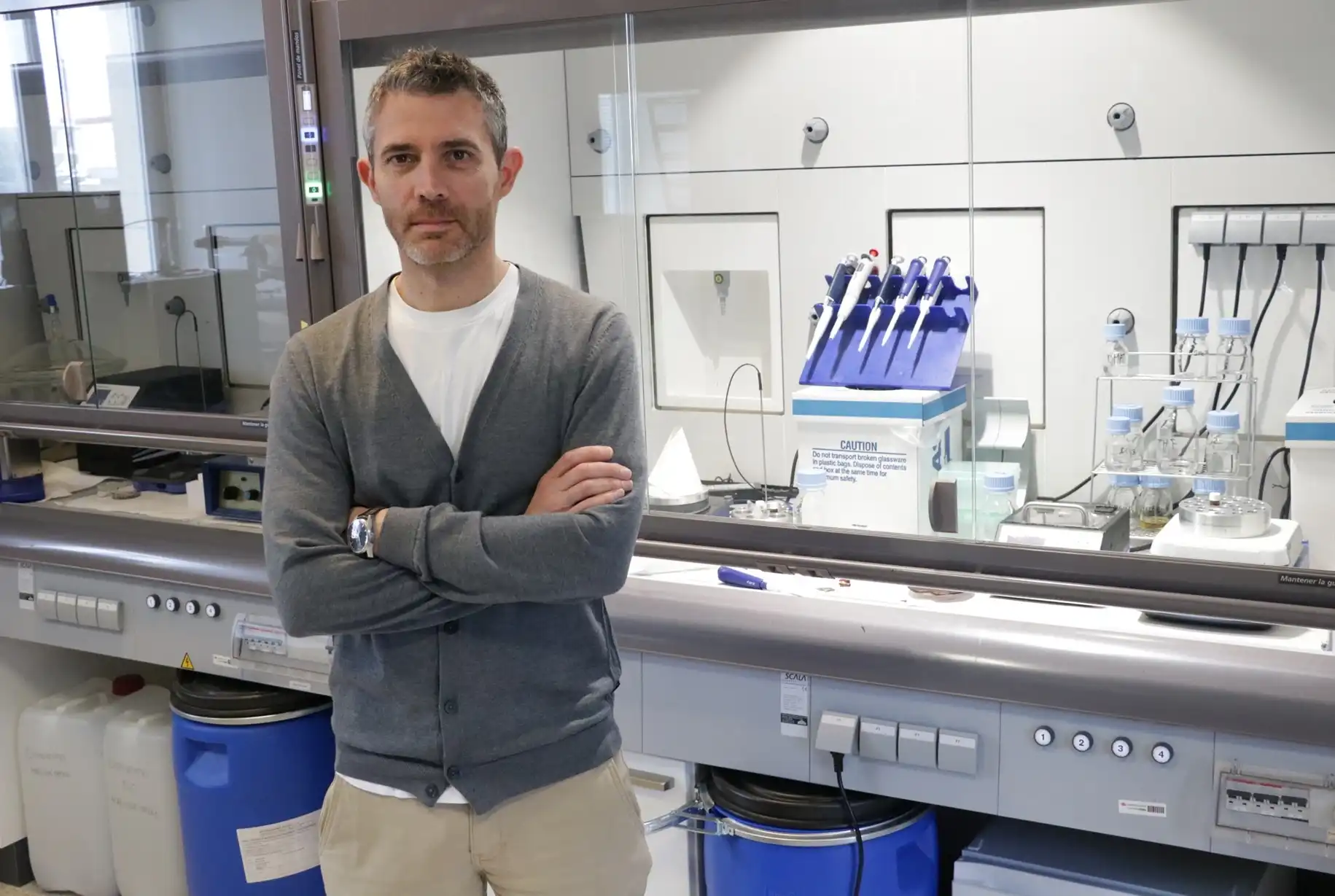
- An international study led by the Research Center for Naval and Industrial Technologies (CITENI), based on the Industrial Campus of the University of Coruña (UDC), describes for the first time a solid phase in semiconductor polymers used in cutting-edge photovoltaic devices.
- The work, published in the prestigious journal Advanced Functional Materials, sheds light on its internal molecular organization, key to understanding its performance and optimizing its manufacturing.
-
The results of this work lay the foundations for designing more stable, efficient and flexible polymers, applicable not only to solar energy, but also to flexible electronics and bioelectronics, an advance
towards cleaner and more sustainable technologies.
Ferrol, May 27, 2025.– Organic solar energy is emerging as an interesting complement to conventional photovoltaic technologies. Compared to silicon solar panels, organic solar cells are made from plastic
materials and are therefore lighter, flexible and potentially more sustainable. Specifically, these devices depend on semiconducting polymers—plastic materials with electronic properties—whose performance is
closely linked to their internal molecular structure.
In this context, an international study led by the CITENI Functional Polymer Laboratory, based on the Ferrol Industrial Campus of the University of Coruña, revealed for the first time a new form of molecular
organization that takes place in these materials: a solid mesophase intermediate between a crystalline order and an amorphous disorder. The work, titled “Decoding the Structure of Benzodithiophene Polymers for
High-Efficiency Organic Solar Cells”, was published in the prestigious journal Advanced Functional Materials.
A mesophase between order and disorder
The study focuses on push-pull semiconducting polymers—which integrate molecular blocks with the capacity to donate and accept electrons, or that favor both light absorption and charge transport—based on
benzodithiazos, a type of compost used in cutting-edge solar devices. Research reveals that these materials are neither simply amorphous nor crystalline, but rather have an intermediate structure: a solid mesophase.
In this hybrid phase, the polymers are organized into a laminar structure, where the main, rigid chains stack up like columns. The more flexible lateral chains form regions with greater mobility.
“Molecular noodles” under the microscope
“The organization of these non-polymer phases, observed under a microscope, is similar to a plate of noodles, where ordered groupings coexist with more disordered ones,” comments Jaime Martín, principal
investigator. This visual metaphor helps to better understand the complex coexistence of order and disorder within the solid mesophase discovered.
Hidden rexiones ata or agora
A major advance in the work was experimental confirmation of less ordered relationships in this type of material. At this time, the typical thermal sinais of disordered materials, such as the glass transition,
will not be observed.
—a gradual change not that the material loses rigidity as it burns—, or that makes its detection difficult in previous studies.
The study also indicates that higher-performance polymers, such as D18 or PM6, present a lower proportion of these disordered reactions, which could explain their greater efficiency.
In heat as an adjustment tool
The work demonstrates that the cement can significantly reorganize the internal structure of these polymers. Depending on their level of order, they go through two or three well-defined thermal transitions. This
capacity opens the door to adjustment processes such as post-deposition thermal treatments: interventions that are carried out after applying the polymer to a substrate in the form of a thin film. These treatments
are key to optimizing the molecular organization and, therefore, improving the performance of two devices.
“We demonstrate that these polymers form a structurally complex phase, which combines order, disorder, rigid zones and flexible zones; and that can best be explained as a new type of solid mesophase.
Understanding this structure gives us a powerful tool to continue improving organic solar technologies,” highlights the team.
An international collaboration with the Galician seal
From the CITENI Functional Polymer Laboratory, Matteo Sanviti, Xabier Rodríguez, Jesika Asatryan and Jaime Martín contributed to the study as co-authors. Along with the UDC team, researchers from centers
and institutions such as the Universidade do País Vasco (UPV/EHU), POLYMAT, or Donostia International Physics Center (DIPC), or Centro de Physics of Materials (CSIC-UPV/EHU), or Singular Research Center
in Biological Chemistry and Molecular Materials (CiQUS) of the University of Santiago de Compostela, or ALBA also participate. Synchrotron, Chalmers University of Technology (Sweden) and North Carolina State
University (USA).
Implications for future solar energy
The results of this work do not provide new fundamental knowledge in the science of materials, as they lay the foundations for designing more stable, efficient and flexible polymers, applicable not only to solar
energy, but also to flexible electronics and bioelectronics. It is a firm step towards cleaner and more sustainable technologies.
Jaime Martín and the Functional Polymers Laboratory
Jaime Martín is an Oportunius researcher and directs the CITENI Functional Polymers Laboratory, located on the Ferrol Industrial Campus. His team works on the design and optimization of semiconductor
polymers to address the fields of organic electronics and solar energy. Martín leads several international projects, including a prestigious ERC Consolidator Grant from the European Research Council, worth two
million euros.
Posted by:
UDC Communications Office