


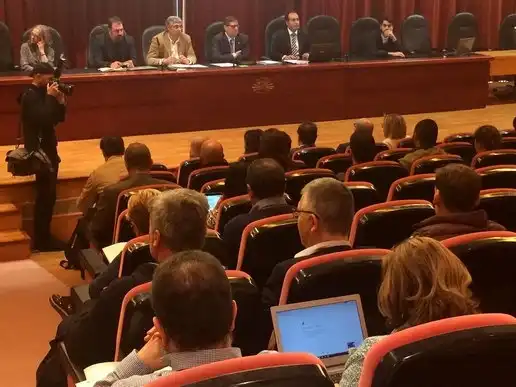
A Coruña, May 15, 2017.- The Rector of the University of A Coruña, Julio Abalde, presented this morning at the Senate session the 2016 Management Report, which was approved by 75% of its members, with 75 votes in favor, 7 against and 18 abstentions.
Senate Speech Rector’s Report 2016
Julio Abalde Alonso, Rector
“Dear attendees,
This is the first time that this government team, which I am honored to chair, has given an account to the meeting of its Management, developed in the first year of the legislature. We do it not only to comply with our statutory regulations but because we firmly believe that transparency and accountability to the society we serve are basic principles on which a democratic and modern government must be based, and we do this account in the university cloister where the teaching staff, the students and the administrative and service staff are represented, that is, the entire UDC community.
We take advantage of this new stage to present a new structure for the Rector’s Report, grouping statistical data by thematic areas: institutional structure area, academic area, research and transfer area, human resources area, economic area and information on the different services. In addition, to facilitate consultation, a first introductory chapter is included in which the main milestones in each of the sections are indicated, separate from the tables and figures.
I will comment below on the aspects that we consider most relevant in the 2016 report.
Reform of the academic structures of the UDC
In October, the Governing Council of the University of A Coruña approved the Proposal for the rationalization of the academic structures of the UDC prepared by the commission created by the Governing Council. This brings to an end the long work that began in May 2015.
We believe that it was a process of dialogue and consensus with all levels and was carried out with transparency, information and dialogue with numerous meetings, incorporating most of the amendments presented. The objective of the restructuring is to improve teaching, promote the transfer of knowledge and research and achieve a more efficient, agile and flexible administrative structure, to face future challenges in better conditions. This Plan represents the first major reform of the UDC structure in its 27 years of existence. The Plan proposes objective criteria to determine the composition of the management teams of the faculties and schools, so that they are proportional to the size of the center’s community, and the suppression of departments that go from 43 to 27.
As indicated in the previous section, the process ended last Friday, April 28, when the representatives of the Centers and Departments were elected in the Governing Council.
This restructuring process was possible due to the constructive and proactive attitude of the teaching staff, the administration and services staff and the students who made possible the culmination of a restructuring process of this magnitude, which is never easy, thanks to the entire UDC community.
Academic:
Degrees:
In the 2016-2017 academic year, the most notable fact is the definitive extinction of the degrees corresponding to the previous academic organization. Only students of the degrees in Computer Engineering, Architect, Civil Engineering, Canals and Ports, Naval and Ocean Engineering and Industrial Engineering will have until the next academic year to complete the Final Project of their degree. The academic offer is consolidated into 38 degrees. Several of these degrees are unique in the Galician University System. The offer of simultaneous programs has also been consolidated.
As regards university master’s degrees, the University of A Coruña currently has a stable and balanced offer between the different branches of knowledge. The offer of new enrolment for this course was 48 master’s degrees. It should be noted that seven of the master’s degrees are considered international master’s degrees, two of them joint with foreign universities.
In the 2016-2017 academic year, four new master’s degrees were implemented:
Master’s Degree in Bioinformatics for Health Sciences,
Master’s Degree in Energy Efficiency and Use,
Master’s Degree in Planning and Management of Destinations and New Tourism Products,
Master’s Degree in Social Policies and Socio-Community Intervention.
Regarding the Doctorate, a new program was implemented in the 2016-2017 academic year: Doctorate in Social and Behavioral Sciences. A total of 36 doctoral programs were offered. The number of doctoral theses defended in 2016 was 273. This figure, which is almost three times the usual number of defenses in an academic year, is due to the conditions for the termination of doctoral programs established in Royal Decree 99/2011. A total of 65 theses received the International Mention, for the achievement of which the grants of the INDITEX-UDC program are proving fundamental. In the 2016 call, a total of 29 students benefited from this scholarship.
Evolution of enrollment:
The number of undergraduate students decreased slightly, from 14,037 in 2015 to 13,913 in 2016. This can be explained by the current complex socioeconomic situation, which, with the tightening of the conditions for accessing scholarships and the demographic decline, is causing a general decrease in the number of university students.
The evolution of enrollment in master’s and doctoral programs at the UDC is very positive. The growth trend of recent years is confirmed. It went from 1,393 master’s students in 2014, to 1,610 in 2015 and to 1,729 in 2016. In doctoral programs, enrollment in 2014 was 560 students, to 865 in 2015, and rose to 985 students in 2016.
We are therefore in a phase of consolidation of the complete structure of the degrees. This new structure requires continuous evaluation of the impact of the new activities. As a result of this evaluation, reforms were made to the academic regulations to accommodate them to the new situation. These new adaptations were only possible thanks to the collaboration and work of the management teams of the different faculties and schools involved, of the International Doctoral School, as well as of the entire university community of the UDC.
Senior University:
On the other hand, the Senior University continues to expand, both in A Coruña and Ferrol. The number of students in the 2016-2017 academic year was 875 students, of whom 604 study on the A Coruña campus and 271 on the Ferrol campus, 76% of whom are women. The presence in different forums and exchanges with Spanish and foreign universities have also continued to increase. Since 2016, the Senior University has been a member of AIUTA, the International Association of the Third Age. In the same year, it also received the Recognition of European Dimension Activities as Good Practices, from the State Association of University Programs for the Elderly (AEPUM).
Quality and evaluation:
This academic year, 22 undergraduate and master’s degrees from the UDC or coordinated by it renewed their accreditation. In addition, the certification process for the implementation of the Internal Quality Assurance Systems of the different centers continued and the Faculty of Philology passed the certification of the implementation of the SGIC with a positive result, so that there are now 10 UDC centers that have their system certified.
Teaching, training and innovation:
The implementation of the process of institutionalizing Service Learning has meant a significant increase in the projects carried out by the teaching community and the entities that have agreements with the UDC. A commitment has also been made to training in virtual and blended learning modalities, offering a total of 11 courses in both modalities. The course “Strategies to increase the visibility and results of research” is maintained, aimed at researchers at our university and designed by the Teletraining Unit in collaboration with the University Library. A second edition was offered this academic year, expanding the offer to doctoral students. I would like to congratulate both the CUFIE and the Library for organizing this course.
With the aim of disseminating the innovative experiences that teachers carry out daily in their classrooms, the CUFIE organized the 1st Teaching Innovation Days of the UDC in October 2016, which had more than a hundred participants.
Internationalization
Internationalization is another of the UDC’s strategic axes and for its development, a series of actions are carried out, such as the promotion of the UDC in the international arena, with attendance at events that make our university known abroad, and the signing of agreements to increase the number of incoming and outgoing students and professors from our university.
In the 2015/16 academic year, student mobility increased again after the slight decrease registered in the 14/15 academic year, due to cuts in scholarship amounts and the increase in language requirements.
lnternational Summer School:
In 2016, the 3rd edition of the International Summer School was held, offering 18 three-week courses, taught in English by professors from foreign universities and aimed at UDC and foreign students. The English teaching program in UDC degrees continues to be consolidated throughout 2016. The results of these programs are already being proven in reality: it is worth highlighting the increase in international students in degrees in which classes are taught in English and the increase in the possibilities of establishing double or joint degrees.
Research and transfer
Research and the transfer of results are strategic commitments of the 2013-2020 strategic plan. At the UDC we have been committed to the continuous improvement of indicators in research and transfer.
The collection of external resources for research during 2016 was more than 13 million euros, increasing 1.4 times the funds obtained in the previous year, this increase was greater in competitive projects and grants, where it went from 4 million euros in 2015 to 8.5 million in 2016. The reason for this increase, in this type of collection of external resources, was largely due to the resolution of state projects in this period.
In the collection of competitive funds, it is worth highlighting the call for scientific infrastructures of the MINECO in 2016, in which the UDC obtained a total of 13 actions with a total amount of 3.36 million euros.
Regarding other research grants, it is worth highlighting that 5 groups of potential growth and 5 new reference groups were granted
In addition, it is worth highlighting the recognition of the Center for Research in Information and Communications Technologies (CITIC) as a Unique Research Center in Galicia for the next 4 years.
It is worth highlighting in the field of competitive grants the Mixed Research Unit (UMI “Shipyard 4.0 or shipyard of the future”) that the UDC has with the company NAVANTIA and which in 2016 developed with full satisfaction.
Contracts and agreements
In the area of transfer, it is worth highlighting the number of contracts signed with companies and public administrations, which were 243, which is the highest figure in recent years. Most of these contracts (135) were managed through the Foundation of the University of A Coruña (FUAC), which at the end of 2016 changed its corporate structure to better develop its activities. The total amount of these contracts with companies and public administrations exceeded 4.5 million euros.
With regard to the acquisition of European grants, it is worth highlighting the one obtained by researcher Carlos Gómez Rodríguez, who had the second of the “Starting Grants” grants that the UDC has and which are linked to the “European Research Council (ERC)” program. The grant obtained is 1.5 million euros in order to research topics related to syntactic language for use in social networks and in simultaneous translation.
As an initiative of the UDC, it is worth highlighting the launch in 2016 of the agreement signed between our university and the INDITEX company for the recruitment of researchers, called InTalent
InTalent UDC-INDITEX.
This program aims to recruit internationally renowned researchers who can obtain competitive international funding for the UDC.
The scientific production of the UDC grew significantly in 2016, reaching a historical maximum of articles with a total of 827. This growth has been sustained over the last five years. In this regard, I would like to highlight the magnificent work of monitoring and making UDC teaching staff visible in bibliographic databases, carried out by the library service staff, both at the central office and at the different UDC centers.
Teaching and Research Staff (PDI):
The access and promotion policies for teaching and research staff in 2016 continued to be conditioned by a restrictive regulatory and economic framework. Although the replacement rate was 100% for the first time, the reduced number of effective retirements in the previous year meant that the public employment offer for teaching and research staff at the UDC was limited to 13 positions in 2016, an insufficient volume to cover both the stabilization needs of teaching staff with a commitment to stability and the promotion needs of a staff that has accumulated around 200 accredited teachers without the possibility of promotion.
In 2016, 8 positions are allocated to the stabilization of Assistant Professors with Doctorates who completed their contracts in 2015 (7 positions for Contracted Professors with Doctorates and 1 position for University Professors) and 3 positions for the promotion to University Professors of accredited Contracted Professors with Doctorates. In accordance with the provisions of article 36 of Law 12/2015 and article 20.2.j of Law 48/2015, two positions are reserved for the recruitment as permanent staff of doctoral research personnel who have completed the Ramón y Cajal Program and obtained the I3 certificate. Additionally, in application of the provisions of the second final provision of Royal Decree Law 10/2015, 4 positions for University Professors are included in the OPE through the internal promotion procedure.
The public employment offer for 2016 is insufficient to allow the stabilization of teachers with a commitment to stability whose contract ends in 2016 and the promotion of all teachers with University Professor positions approved by the Governing Council in 2012. After prioritizing the only University Professor position approved in that same year, the OPE allows the launch of a first call for applications so that Contracted Doctor professors accredited to access the University Professor body can request the creation of one of the two positions offered in their area of knowledge. More than 40 teachers applied for this call.
The efforts of the UDC governing bodies focused on minimizing the effects of this restrictive context, maintaining stable staff numbers, prioritizing the stabilization of teachers and maximizing the possibilities for promotion after the blockade imposed between 2012 and 2015.
In addition, we can highlight the following measures:
– The program to reduce the number of Temporary Substitute Professors is maintained with their transformation through competitions into Assistant Professors with Doctorates: 20 competitions were held in 2016.
– The suspension of the possibility of calling for Assistant positions is maintained. The suspension of the hiring of new emeritus professors is also maintained until a regulatory framework for their appointment is defined.
– In 2016, 66 competitions for Associate Professors or Temporary Substitute Contracted Professors were held for the temporary provision of PDI positions to cover urgent teaching needs.
Administration and Services Personnel (PAS):
As a continuation of the processes initiated in 2015, the following actions were carried out in 2016:
Call for the third phase of the civil service process in accordance with the calendar established in the Agreement signed with the trade union centers in July 2012. This fact is what determines, compared to the data collected in the reports of previous years, a substantial increase in PAS civil servants and the corresponding reduction in the number of employees.
Publication in the Official Gazette of Galicia number 10 of January 18, 2016 of the list of job positions for administrative and services civil servants.
With this new RPT, the following are sought: organizational and career improvements; opening of subgroups for the assignment of special subscale positions, to facilitate the professional promotion of civil service personnel; the reorganization and reinforcement of the International Relations Office; inclusion of linguistic profiles in Research service units, also reinforcing staff for the collection and management of European funds; reorganization of concierge services in the centers; better structuring of IT and Communications services.
Students
Different actions related to the Employability of our graduates have been carried out. Among these we highlight the participation of the UDC as a collaborating center in the YUZZ project. This project provides participants with training, support and personalized advice during the development of the business plan.
Scholarships
To compensate for financial difficulties that prevent students from continuing their studies leading to an official degree, the University of A Coruña has granted 41 grants to students in financial difficulties. Also with the aim of promoting equal opportunities in the field of university education, 213 grants for accommodation were granted during the 2016-2017 academic year.
University Extension: Culture and Sports
In the Culture Area, in addition to a new edition of the International University Theatre Festival of A Coruña (FITEUC), it is worth highlighting the exhibition BDG70 THE REVOLT OF GALIA COMICS, in NORMAL. This exhibition highlighted a large number of artists who, even during the dictatorial period, channeled their anti-authoritarian and artistic thinking through a still marginal medium, comics, and an allegedly marginalized language, Galician.
In the sports area, it is worth noting that the eighth edition of the UDC Sports Awards went to Carlos Lalín Novoa, a doctor in Physical Activity and Sports from the UDC, and a physical rehabilitator who developed his career in teams such as Deportivo, Real Madrid, Chelsea and Manchester United.
Scientific and cultural dissemination
Among the various scientific dissemination actions, it is worth noting the creation of the Isabel Zendal Scientific Dissemination Chair promoted by the City Council of A Coruña. It was presented on Wednesday, December 21, at the “Isabel Zendal” Scientific Dissemination Conference with the participation of the writer Javier Moro and the journalist Antonio López Mariño, great experts and researchers of the life and work of Isabel Zendal.
Budgets and settlements
On 21 April 2016, the Social Council approved the budgets of the University of A Coruña for the year 2016, which were extended since the elections for the Rector for the period 2016-2019 were held in December 2015.
The UDC budget for 2016 was 116.32 million euros. This amount represents an increase of 0.13 million, which is equivalent to an increase of 0.11%.
The differences between 2015 and 2016 that can be observed between the different expenditure concepts are few. The most important financing component corresponds to contributions through current transfers, which represent 73.29% in 2016 -compared to 71.20% in 2015-. Academic fees also represent a significant income, specifically 13.19%. Finally, capital transfers reached 12.80%, which is down 13.68% from the previous year, going from €15,900,847.60 to €14,888,806.49.
Regarding expenses, the budget responds to the commitments to maintain staff and preferential treatment for scholarships and student grants in order to mitigate the effects of the reduction in public aid for equal access to university. Likewise, the percentage of spending on goods and services increased by around 2%, while current transfers fell by 16%.
There is a notable drop in investment of 22.7%, going from €11,843,366.35 in 2015 to €9,155,702.45 in 2016.
Infrastructure
The main action undertaken as a result of the efforts initiated in 2014, the renovation and expansion work of the CITEEC building, awarded for €1,689,945.07, which at the end of 2015 was more than half of the contract execution. In 2016, the work was completed, which was received in August 2016. This work represents a major advance in the building and civil engineering infrastructure for this university.
Environment
Green Campus Program
On June 20, 2016, the “GRENCAMPUS IN UDC CENTRES 2016” conference took place at the Faculty of Educational Sciences (Elviña) and the ETS Architecture (A Zapateira). These two centers submitted to the external evaluation by ADEAC in September 2016 and both achieved the Green Campus Flag, which is added to those achieved in 2015 by EUAT and FCS.
Likewise, throughout 2016, three new UDC centers joined the GreenCampus program: ETS Civil Engineering (January), Faculty and Philology (July) and Faculty of Physiotherapy (December).
The Green Campus program is developed within the framework of a collaboration agreement between the University of A Coruña and the Association of Environmental and Consumer Education (ADEAC), the latter as a member of the international Foundation for Environmental Education (FEE), signed in February 2014.
UDC in the 2016 GreenMetric International Ranking
The GreenMetric Ranking of World Universities compares the efforts of universities towards environmental sustainability and environmentally friendly management policies. The University of A Coruña was included for the first time in 2016 and achieved position 149 worldwide (71st percentile, among 516 universities from 75 countries), and number 13 at the national level, out of a total of 27 Spanish universities, being the first in the Galician University System.
Social Responsibility:
Diversity Care Unit
Inclusive Campuses: The UDC together with the ONCE Foundation, the REPSOL Foundation and the Ministry of Education, Culture and Sport jointly launched a new call for applications for the “Inclusive Campuses. Campus without limits” program in 2016, with the main objective of increasing the active presence of people with disabilities in Spanish universities.
Shared Space: Thanks to the signing of a new collaboration agreement (December 1, 2016) between the University of A Coruña, the Universia Foundation and Banco Santander, the development of the Shared Space Program will continue. University training program in personal, social and basic skills aimed at young people with mild cognitive disabilities.
Scholarships for students with special needs: Each year, the University of A Coruña announces 20 grants on a competitive basis for students with special educational needs enrolled in the centers of the University of A Coruña. In 2016, external funding was obtained for these scholarships through an agreement with the “La Caixa” Banking Foundation.
Inclusive Mentoring Program: Under the agreement signed with the “La Caixa” Banking Foundation, the Inclusive Mentoring program began to be developed at the University of A Coruña, specifically designed to improve the employment opportunities of UDC graduates with disabilities.
Office for Gender Equality
The International Day of Women and Girls in Science was celebrated with different events as well as the institutional event of Women’s Day at the Escola Politécnica Superior
In collaboration with the Xunta de Galicia, the Exhibition of the “María Josefa Wonenburger” award winners of the Women and Science Unit of the Xunta de Galicia was held
Among the activities Against gender violence is the creation of a website for material prepared at the UDC against gender violence, among which are videos of awareness against gender violence prepared by students of the Faculty of Nursing and Podiatry of Ferrol
Center for Gender and Feminist Studies
On November 29, 2016, the first issue of the CEXeF magazine was presented: Atlánticas. International Journal of Feminist Studies.
UDCHealthy
The UDC joins as a founding member of the “Spanish Network of Healthy Universities” Association. Between October 3 and 7, the II UDC Healthy Week is celebrated.
Campus de Ferrol
Specialization Campus Industrial Campus
On July 8, 2016, the presentation ceremony of the Industrial Campus took place, with the presence of the president of the Xunta de Galicia. On August 1, 2016, a new agreement was signed between the Ministry of Culture, Education and University Planning and the UDC for actions in the technology transfer centers and units and in the Ferrol Industrial Campus. Since July 2016, Prof. Dr. Ginés Nicolás has been the director of the Ferrol Industrial Campus.
During this year, delegations from different foreign universities visited the Ferrol Industrial Campus, such as the Surgut State University (Russia) and a group of universities from Australia.
Jorge Juan Chair
The University of A Coruña and the Navy jointly manage the activities of the Jorge Juan Chair. Each year, on an alternating basis, it is up to one or the other institution to appoint a director. Until September 14, 2016, the director was UDC professor, Ms. Mª. Carmen Ramírez Gómez, whom we would like to thank for her work. From this date, the director of the chair is Captain Commander-Director of the “Antonio de Escaño” School of Specialties, Alfonso Vallés Sales.
This is a non-exhaustive summary of the most outstanding actions developed by the government team during the past year 2016. This is the result of the first year of management but cannot be considered in isolation but in some cases they are programs and policies developed in recent years on an ongoing basis. Therefore, the results achieved cannot be understood without taking into account the political action of previous UDC teams that initiated some of the strategic lines.
Posted by:
Communication cabinet