


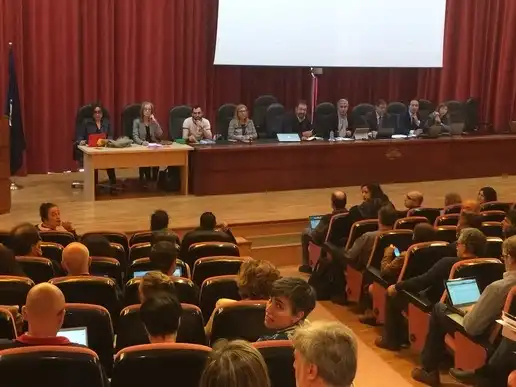
A Coruña, 16 May 2018.- The University Senate approved this morning the 2017 Management Report of the Rector with 53 votes in favour, 16 abstentions and no votes against.
Julio Abalde presented his management of last year and proceeded to open a debate with the attendees after which a vote was taken. Abalde thanked the participants for their participation in the debate and the calm and constructive tone of the interventions. The University Ombudsman then presented, following the established agenda, his Management Report for the years 2016-2017.
Speech of the Rector, Julio Abalde, before the Senate:
“The climate of stability and normality in which 2017 passed allowed the government team that I am honored to preside over to take important steps in the development of the current UDC Strategic Plan.
The improvement in the economic scenario and the change in the trend of our budgets allow us to gradually recover the ground lost in the worst years of the crisis.
Fulfilling one of our pending commitments, in April the new departmental structure was launched, reduced to 26 new departments (previously there were 43), in application of a UDC infrastructure rationalization plan. Objective: efficiency and agility. The year has already closed with new directors in office, as well as the deans and directors of faculties and schools where the government teams were renewed.
Our University already has a consolidated offer of 37 degrees and 51 master’s degrees, many of them inter-university. In 2017, the Galician government and universities agreed on a new map of degrees, in principle valid until 2021. Until then, our A Coruña campuses will incorporate five new degrees, the first of which will be the degree in Landscape, the first of an inter-university nature in Galicia, and the degree in Fashion Industrial Management, a pioneer in the Spanish university system. Both will strengthen the offer for the next academic year.
A responsible and efficient institutional collaboration is also behind the execution of the works of the Elvira Bao university residence, underway since January. Finally, the University of A Coruña will have a public residence (120 places) for its students. An old demand of our university community that we will soon see become a reality thanks to the support of the Provincial Council and the City Council of A Coruña. The Provincial Council and the City Council are also collaborating with us in the renovation of the athletics track of the Elviña sports complex.
We work with the criterion of extending as much as possible the teaching, scientific and technical relations with our socio-economic environment. In 2017 we signed 738 agreements. More than half a thousand were to provide internships for our students, another 140 were of a specific nature and in 44 cases they were framework agreements.
The Joint Research Unit that the UDC has with Navantia in Ferrol is a good example of the good results that can be achieved by following lines of collaboration with both public and private institutions.
Three new institutional chairs allow us to maintain open collaboration with our environment, facilitate internships and the employment of our graduates and establish formulas for cooperation in the field of R&D&I. That same line of collaboration with companies and institutions, which we keep active with regular contacts and visits, allows us to have such important scholarships for the training of our students as those of the Intalent program (sponsored by Inditex), those financed by Banco Santander or those of ONCE to help students with disabilities.
Institutional collaboration and synergies are also foundational concepts for the Center for Advanced Scientific Research, the fourth of our technological centers. The CICA already forms a solid strategic grouping with INIBIC.
In this 2017 Report we note, among many other things, the new steps taken in the internationalization process of the University of A Coruña, as well as in the search for teaching excellence, which is increasingly demanding, supported by innovation, internal quality assurance systems and permanent updating.
Regular visits to the centers and meetings with PDI and PAS from all the centers in A Coruña and Ferrol allow us to maintain direct communication channels with the entire university community and fulfill our commitment to transparency.
In this direction of participation and transparency, two important initiatives also go. The first is the launch of the UDC participation portal, UDCDecide. We consider this participation platform as a first step, which guarantees a direct communication space between the university community and the Rector’s team and Dean’s teams.
The second is, since the beginning of the 2017-2018 academic year, the new UDC-mobile application for Apple and Android devices, created by the Computer and Communications Service.”
Rector’s Report to the Senate. Executive Summary:
Research and Transfer
The scientific policy focuses on promoting scientific excellence and research specialization as basic axes that, with transfer, enable the improvement and positioning of the UDC in fields of high strategic value.
Competitive acquisition of resources
The acquisition of external resources for research during 2017 amounted to around 8 million euros, down from the previous year but doubling what was achieved in 2015. The reason for this staggered trend has to do with the distribution of calls and the resolution. It is to be hoped that the increase will be noticeable in the resolution of competitive projects in 2018, which were requested during 2017, since in some cases, such as the European calls that UDC researchers and groups attend, the number of applications tripled.
Regarding other research grants, it should be noted that the General Secretariat of Universities called for and resolved grants for competitive reference groups, groups of potential growth and networks, which involved raising 3.6 million euros. It should be added that the Information and Communications Technologies Research Center (CITIC) as a Singular Research Center of Galicia and the renewal of the CICA-INIBIC strategic grouping.
Additionally, during the year a total of 2.6 million euros were obtained for research infrastructures, as a result of participation in the last competitive call of the MINECO. This contribution of infrastructures, distributed between research centers and institutes, was co-financed with 80% of FEDER funds and the remaining 20% through a contribution from the General Secretariat of Universities.
In the field of competitive aid from the Department of Industry, we must mention the work carried out by the Mixed Research Unit (UMI “Shipyard 4.0 the shipyard of the future”) that the UDC has with the public company Navantia, since during this 2017 it successfully achieved a total of 17 joint research actions which means the hiring of 23 new researchers by the different research groups.
It is worth highlighting that the relationship with the Navantia company is also giving rise to other interesting collaborations, such as the co-supervised training of doctors with the Australian university RMIT in Melbourne, financing various research projects by the Navantia-Australia subsidiary.
Contracts and agreements
In the area of research and technology transfer from research to the industrial fabric, we highlight that the number of contracts with companies and public administrations signed by UDC researchers was 217, a lower figure than last year, although with a higher average cost per contract. Most of these contracts (139) were managed through the University of A Coruña Foundation (FUAC). The total amount of these contracts with companies and public administrations exceeded 3.1 million euros.
Grants and research contracts
With regard to the grants and research contracts obtained by researchers, the data are similar to those of previous years, despite the decrease in FPI grants, which went from five in 2016 to only two, in any case in line with the lack of new calls for projects from the MINECO resolved this year.
As an initiative of the UDC, launched during the previous year, the second INTALENT call took place, an agreement signed between our University and the company Inditex to recruit researchers. This program aims to recruit internationally renowned researchers who can obtain competitive international funding for the UDC. Two new researchers entered this second call. It is worth mentioning that the researcher selected in the first call, Elena Pazos, obtained one of the competitive grants of the Retos project.
Scientific production
The scientific production collected in the Web of Science continues in a good trend, with 916 articles published in 2017, very similar to the previous year, when the record was broken (924), noting an increase in the quality of publications with an increase in the number of publications in the first quartile (Q1).
Patents
The number of patents applied for and granted increased. A total of 18 patents were granted (8 patents were granted in 2016). In software licenses, a considerable increase in the number of registrations was observed, which went from 4 in 2016 to 15, recovering the trend of other years.
Technology centers
It is worth highlighting the consideration of CITIC as a Singular Center, which represents an income of €430,000 in 2017. Resources from competitive R&D&I calls increase slightly in this center, going from the 4.1 million raised in contracts and agreements.
Regarding the Center for Advanced Scientific Research (CICA), the work focused on renewing the strategic grouping and launching the laboratories. This strategic grouping, under the acronym CICA-INIBIC, has the mission of creating a multidisciplinary and synergistic environment to respond to biomedical, technological and environmental challenges through research, training and the transfer of integral solutions that generate scientific and economic value and social progress.
CITEEC has obtained more than one million euros in state aid for infrastructure and equipment. The number of research projects supported by CITEEC has increased from four in 2016 to five, but they are still far from the nine in 2015. This is offset by the increase in agreements with companies supported by CITEEC (28 agreements).
The number of CIT research projects has dropped this year from 25 to 11. This decrease is motivated by the fact that several of the CIT groups are collaborating very actively with the Joint Research Unit with Navantia, which counts as a single project, although with a total budget exceeding 3 million euros.
Institutional chairs
Three new institutional chairs have been signed, which increase the necessary collaboration with companies.
The Cosme Álvarez del Río Chair with the company Navantia.
The Emalcsa Chair, with the Municipal Water Company of Coruña.
The Everis Chair of Digital Transformation with the company EVERIS.
Teaching and innovation
In addition to the degrees and master’s degrees offered, which were discussed above, in the 2017-2018 academic year a total of 36 doctoral programs were offered and 163 doctoral theses were defended, with a very balanced gender balance, as has been the case in the last five academic years. This figure continues to be above the average number of annual theses at the UDC -located around 120- due to the conditions for the extinction of doctoral programs established in Royal Decree 99/2011. A total of 44 theses received the International Mention, for the achievement of which the grants for doctoral student stays financed by the Inditex-UDC program are proving to be fundamental. In the 2017 call a total of 35 students benefited from them.
Evolution of enrollment
Regarding the evolution of enrollment in the different degrees, we can establish some important differences between degrees, masters and doctorates. The number of degree students experienced a slight decrease, going from 13,913 in 2016 to 13,772 in 2017. However, the evolution of enrollment in masters and doctoral programs at the UDC is very positive. The uninterrupted growth trend of recent years is confirmed: it went from 1,393 master’s students enrolled in 2014 to 1,838 in 2017, and from 560 doctoral students in 2014 to 1,101 in 2017.
We are, therefore, in a phase of consolidation of the complete structure of the degrees, which is possible thanks to the work of the management teams of the different faculties and schools involved, of the International Doctoral School, as well as of the university community as a whole.
Senior University
Regarding the Senior University, it should be noted that it is constantly expanding, both in A Coruña and Ferrol. Enrollment in the 2017-2018 academic year was 954 students. It is important to highlight an important difference between the number of male and female students enrolled, as the percentage of female students enrolled is three times that of male students. The Senior University curriculum has increased the training offer to reach the current situation, with 20 subjects on the A Coruña campus and 16 on the Ferrol campus, in addition to 10 workshops between the two campuses.
Likewise, both the presence in different forums and the exchanges with Spanish and foreign universities continued to increase. Between 2017 and 2019, the Senior University will participate in the “TICTac+55: Combined Learning Techniques for People 55+ regarding ICT” Project within the Erasmus+ Program. As a result of a collaboration agreement with other European adult education institutions, the Senior University participated in the International Meeting of the ECHO project in the town of Scandiano.
Quality and evaluation
17 undergraduate and master’s degrees from the UDC or coordinated by it have had their accreditation renewed. The UTC worked on the review, update and modification of the internal quality assurance systems (SGIC) of the centers and the International Doctoral School, in collaboration with an inter-center working group, made up of the quality managers of the centers that have certified the implementation of the SGIC. The UTC also provided special support and advice to the doctoral programs, on the occasion of the approval by the ACSUG of the Guide for the monitoring and accreditation of two official doctoral degrees.
Likewise, in 2017, the VI call for applications for the Docentia program was published, in which 193 teachers were evaluated. It is necessary to make a positive assessment of the results of the final assessments achieved, since 30.88% obtained an excellent rating; 66.18%, remarkable; 2.21%, acceptable, and 0.74%, insufficient.
Teacher training and innovation
In 2017, a new call for Teaching Innovation in Service-Learning was published, in which 16 projects were certified.
As a result of the important commitment being made to teaching innovation, the 1st Call for Educational Innovation Groups (GIE) was published, which resulted in the creation of 79 GIEs, bringing together 550 teachers. The CUFIE also organized the summer course Connected Teachers, which allowed for the exchange of knowledge and experiences between teachers from different educational levels and prominent personalities in the field of educational innovation. Similarly, the 2nd Teaching Innovation Conference was held to share the most innovative experiences that are being put into practice in the classrooms of our university. Finally, regarding infrastructure, it should be noted that this year a training classroom with 25 new equipment was opened in the Xoana Capdevielle Building.
Internationalization
Through the International Relations Office, measures have been implemented to promote mobility for study purposes, such as providing first-hand information to students (through traditional formats and digital channels) or increasing the number of months funded for annual mobility. A similar increase has been applied to the internship section for students, with internship exchanges of up to 10 months being funded. Actions to increase staff mobility have involved an increase in the amounts initially granted by SEPIE, which is translating into an increase in these mobilities.
These actions were supported by measures such as the first call for the improvement of students’ language skills, as well as the first call for linguistic mentoring which served a dual purpose: the integration of foreign students and internationalization at home.
To promote the internationalization of our campuses, we are supporting double or joint degrees, participation in KA2, KA3 or “capacity building” projects with partners from outside the EU, the recruitment of international students through external outreach activities (attendance at fairs, organization of the ISS, work with agents) and the improvement of information on admission.
Work was also done to improve the support plan for teaching in English, introducing for the first time the call for the improvement of the linguistic skills of the teaching staff as a measure of language strengthening prior to the EMI course. In this sense, the visiting professors’ program from English-speaking countries was established for the teaching staff who were teaching in English. The impact of these measures is reflected in an increase in credits taught in English, which includes the incorporation of subjects in new degrees.
Teaching and research staff (PDI)
The access and promotion policies for teaching and research staff entered a phase of relative normalization in 2017, despite continuing to be conditioned by a restrictive regulatory and economic framework. Although the replacement rate remained at 100%, the 2017 Law on the Accompaniment of the General State Budgets allowed the addition of the places on leave without job reservation that occur when each promotion is effective, so the public employment offer for teaching and research staff at the UDC was expanded to 43 places. This increase allowed the accumulated backlog to be recovered with the needs for stabilizing teaching staff with a commitment to stability and, in addition, to address the promotion needs of a staff that exceeds 200 accredited teachers.
The public employment offer was, therefore, sufficient to stabilize the teaching staff with a commitment to stability whose contract ended in 2016 and 2017 and for the promotion of all teaching staff with university professor positions approved by the Governing Council in 2012. The OPE also allowed the call for 9 positions so that contracted teaching staff with an accredited doctorate to access the body of university professors could request the creation of a position in their area of knowledge and, for the first time since 2012, the call for 7 university professor positions for accredited teaching staff. Around a hundred teachers applied to these calls, regulated by the criteria negotiated and agreed with the PDI representative bodies.
Together with the state and regional legislative framework, which conditions the development of policies for stabilizing, promoting and hiring teachers, the economic aspects related to maintaining the salary mass add an additional difficulty to teacher policy.
The annual increase in three-year and five-year terms, derived from the vegetative growth of the staff, and the six-year terms of research and regional supplements, means that the budget of Chapter I is placed within the limit of the personnel costs established by the budget laws for the UDC. The resources to finance the amounts corresponding to these concepts, as well as the amounts of the positions to maintain the figures included in the II Collective Labor Agreement with a commitment to stabilization and the positions to meet urgent and unavoidable needs, are very limited and come basically from retirements.
These limitations condition the hiring of new staff, with the consequent scenario of lack of renewal and instability for educational projects, research or transfer of their results to society, which are of such concern to the entire university community. The efforts of the UDC governing bodies have focused on minimizing the effects of this restrictive context, maintaining stable staff numbers, giving priority to stabilizing teachers and researchers who have been successfully trained at our university and maximizing promotion possibilities after the blockade imposed between 2012 and 2016.
In addition to the agreements reached for the approval and execution of the public employment offer, the following measures stand out:
– The program is maintained to reduce the number of temporary substitute teachers who were not previously doctoral assistants, and associates who have accreditation, by transforming them through competitions into doctoral assistant teachers. In 2017, 20 positions were announced in this program.
– A new regulatory framework for the appointment of emeritus and honorary professors was approved. In 2017, five new emeritus professors and one emeritus professor were appointed, as well as four professors and one honorary professor.
Administration and services staff (PAS)
In 2017, the following actions were carried out:
• Call by Resolution of April 3, 2017 (DOG no. 73, of April 17) for the process of providing jobs for administrative and service staff at the University of A Coruña.
• Completion of the internal promotion process corresponding to the Public Employment Offer of the year 2016, called by Resolution of August 31, 2016 (DOG no. 182, 09-23-2016) for entry into the different scales of civil service personnel of the University of A Coruña. A total of 151 appointments were published.
• Publication in DOG number 198, of October 18, 2017, of the Resolution of October 5, 2017 with the public employment offer for administration and services staff for 2017. This offer included a total of 21 places to be called for the open access round and 50 places to be called for the internal promotion round.
Students
This year, various actions were carried out to improve employability and entrepreneurship, as well as to promote professional internships and cross-training activities. In this regard, it is worth highlighting the reform of the Employability Improvement program in its second edition, with 299 students participating.
A doctoral student orientation program was launched to respond to their specific training/information needs on employability.
For its part, the Employment Unit, which offers general and also specialized advice to create Technology-Based Employment Initiatives, began managing the ONCE-CRUE Foundation internship scholarships for students with disabilities.
Regarding the dissemination of the UDC for future students, SAPE organizes the “Visit your campus” program for ESO, baccalaureate and FP students and informative talks in centers. An effort was made to increase from 41 to 72 centers visited. It is also worth mentioning the collaboration with the City Council of A Coruña in the annual “You choose!” day, which is organized at the CUR, with more than 5,000 students.
Scholarships
The number of collaboration scholarships for complementary training, UDC-Santander scholarships for master’s studies and urban transport grants is maintained. In addition, to compensate for the financial difficulties that prevent some students from continuing their studies, the University of A Coruña granted 39 scholarships and doubled the budget for these grants. Also with the aim of promoting equal opportunities, a total of 222 grants for accommodation were granted in the 2016-2017 academic year.
Publications
The Publications Service continued to manage the editing, dissemination and marketing of books and magazines and enriched its editorial catalogue with 16 new volumes. It also presented three new issues of periodicals, bringing the total to 16. It is worth noting that the OJS application was updated to version 2.8, and that 13 of the 16 magazines are in OJS, and 12 of them receive DOIs.
Sports
The 9th edition of the UDC Sports Awards went to Alberto Seoane Alcaraz, in recognition of his long sporting career. He was world team champion (2014 and 2017), gold at the Slovakia Open (2015) and double medalist at the Rio de Janeiro Olympic Games (2016). He is tenth in the world ranking of table tennis for the disabled.
In the internal university leagues, 104 teams participated in modalities such as 7-a-side football, basketball and futsal. The UDC athletes with medals in the Spanish University Championships were Sara García Suárez, silver medalist in taekwondo in the 57 Kg category; Sofía Pérez Riesco, silver medal in taekwondo in the 73 Kg category; Paula Iglesia Garnello, silver medal in athletics in 400 ml. Miguel Riopedre won a bronze medal in the European Judo Championship in the 60 Kg category.
Disclosure
The Scientific and Cultural Outreach Unit, in collaboration with the Provincial Council of A Coruña, convened the 2nd edition of Expociencia-UDC to promote scientific communication. On November 30, the 2nd “Isabel Zendal” Scientific Outreach Conference was held. The Day of Women and Girls in Science was celebrated with a series of short talks given by professors and students of the UDC, who spoke about the lives and scientific achievements of various pioneers in different fields of science.
Culture
The twenty-fourth edition of the International University Theatre Festival of A Coruña (FITEUC), organized by the institution, was held. In November, the exhibition As Noites interiores by Jesús Madriñán was inaugurated at Normal, which brought together for the first time, and in the same space, the most recent photographic series of the Galician artist.
Courses and conferences
It subsidized a total of 43 activities, including courses, conferences, seminars, meetings and conference cycles. On May 31, the Regulations for University Extension Courses were approved, which regulate the non-regulated activities organized by the UDC.
Complementary activities
The UDC organizes Easter and summer camps for children of members of the university community, but also open to outsiders.
In the Mauro Silva camp, which was organized for the seventeenth consecutive year during the Easter holidays, 112 children between the ages of four and twelve participated. They took part in sports activities, study habits and English. In the summer, camps were held for primary school children on the A Coruña and Ferrol campuses, with a total of 360 boys and girls.
Budget and settlement
On December 22, 2016, the Social Council approved the budget of the University of A Coruña for the year 2017. The Annual Operating Plan and the budget for the year develop the General Lines of the 2017 budget, approved by the Senate on December 14, 2016. The budget was 119.45 million euros. This amount represents an increase of 3.13 million euros, which is equivalent to an increase of 2.69% compared to 2016.
Income from tuition fees in 2017 has already ceased to be affected by the adaptation of degrees to the EHEA, although it is necessary to take into account the downward demographic forecast when estimating this concept.
It is worth noting that credit was allocated to undertake the recovery of the specific or equivalent supplement attributable to the extra pay. Consequently, the current expenditure foreseen in Chapter I increased by 2.16%. The total amounted to 90.29 million euros, which represents almost 75.59% of the total expenditure.
A reduction in current expenses (-5.09%) is expected due to the implementation of expenditure rationalization measures and the start of energy efficiency programs. The total amounts to 14.49 million euros, which represents a weight of 12.13%.
In the real investments section, an increase (20.78%) was recorded due to the need to finance measures or investments leading to energy savings or equipment for works and infrastructures.
Revenue from fees, public prices and other income increased by 6.57% to 16.35 million euros. The increase was mainly due to the increase in miscellaneous income and other income from the provision of services (rents, indirect costs and billing for the provision of research services).
As for current transfers, they have increased fundamentally due to the recovery of the specific supplement or equivalent applied to the extra pay. In short, there is an improvement in financing by results both in absolute and relative terms.
Regarding the settlement of the 2016 financial year, the revenue estimates were quite accurate since the actual revenue from fees, public prices or other revenues (€15.18M) almost reached the figure estimated at the beginning of the year (€15.34M). Similarly, there was a notable increase in current transfers (€87.36M compared to €85.26M) while capital revenues also remained very close to expectations.
Although the 2016 budget result shows a deficit of €1.64 million, there is a notable improvement compared to 2015, since in that year the deficit amounted to €4.78 million. This means going from a deficit, measured as a budget balance over the budget, of 4.1% in 2015 to a deficit of 1.4% in 2016. In this way, according to the settlement carried out in 2016, the unaffected treasury remainder that amounted to €2.45 million in 2015 became €3.09 million.
It is worth noting that there has been an improvement in the average balance payable to suppliers, since in 2014 it was 5.56% with respect to the budget, in 2015 it fell slightly to 4.6%, while in 2016 it stood at 2.1%.
Infrastructures
The most important actions focused on works that involved a significant investment to carry out reform or rehabilitation projects such as the Maestranza square, the university residence or the sports stadium.
The works in the Maestranza square, carried out to renew more than half of the slab, lasted for two months. Meanwhile, in September, the renovation of the entrance to the Stadium and new sports fields began. Weather problems caused a delay and were pending completion in 2018.
Regarding the university residence in A Coruña, progress has been made to a level of execution of 70%. The work is expected to be completed in the first half of 2018. Once the works are completed, a city bus stop will be prepared with the City Council, Wi-Fi will be installed and rooms, dining and laundry services will be equipped.
On the other hand, the policy of maintaining the purchase of electricity in three centers and the possibility of joining the Redexga network to obtain better electricity and gas consumption rates continues. Energy certifications have also been obtained in 11 buildings on the Ferrol Campus.
Environment
Five centers on the A Coruña and Ferrol campuses already have the Green Flag and the program is underway in four other centers.
We are taking significant steps in terms of environmental sustainability. And these steps are reflected in the positioning of our University in the GreenMetric ranking of universities in the world. The UDC is in 86th place among the 619 competing campuses in the 2017 edition.
Social Responsibility: Attention to diversity
– SAPDU Network: The UDC has been part of this network of diversity services for all Spanish universities since 2014. In 2017 we began coordinating the Communication and ICT working group, in which 5 other universities participate.
– Shared Space: We submitted applications to the ONCE Foundation for university employment programs aimed at young people with intellectual disabilities. 15 universities were selected in this call. The UDC program obtained first position.
– Scholarships for students with special needs: Every year the University of A Coruña announces 20 grants, on a competitive basis, for students with special educational needs. In the 2016-2017 academic year, the ONCE-CRUE scholarships for extracurricular internships for students with disabilities were announced for the first time. At the UDC, 6 students benefited from this scholarship.
– Inclusive Mentoring Program: Under the agreement signed with the “La Caixa” Banking Foundation, the Inclusive Mentoring program began to be developed at the UDC, specifically designed to improve the employment insertion of graduates with disabilities.
– UDC-U Network (UDC Universal): Tutoring Action Plan for students with functional diversity: Within the Tutoring Action Plan, each center establishes a specific tutor for students with functional diversity or specific educational needs.
– Diversity-related internship program: One of the unit’s most important initiatives is to establish an internship program that connects students from different degrees on topics related to diversity.
Office for Gender Equality
• Among other initiatives, the Office for Gender Equality organized the courses Teaching and university social responsibility and Policies and Policies on equality and gender violence, within the Apopio Plan for Teaching.
• Commemorative Events: February 11: International Day of Women and Girls in Science. A scientist seen at our school. In public schools in Ferrol during the month of February. Collaboration with the City Council of Ferrol and the AMIT_GAL association.
• March 8 Institutional event at the Architecture ETS.
• November 25. Prevention and awareness-raising sessions on sexual violence in youth. Information stands.
• Exhibitions: Edition of the exhibition “Women in the libraries of the UDC”. Women in the Nobel Prizes and “María del Milagro Rey Hombre, architect, 1930-2014”.
• Organization of conferences: 5th Galician University Conference on Gender, in Vigo, in collaboration with the equality units of the USC and Uvigo. Conference on the prevention and awareness of sexual violence in youth.
• Competitions: 5th Edition of the Angeles Alvariño Academic Works Competition with a Gender Perspective and 5th Edition of the Rosalind Franklin Photography Competition.
Center for Gender and Feminist Studies
This center organized the 5th edition of the History of Feminist Theory Course, articulated around the retrospective and chronological reconstruction of feminism as an intellectual tradition and social movement. Also the 3rd Feminary of the Center for Gender and Feminist Studies. In this case, the program brought together the presence of representatives of institutions promoting gender equality and feminisms and university students who in the current or past courses presented TFGs and TFMs that were characterized by the presence of a gender perspective.
The Center for Gender Studies organizes the summer course “Gender equality in the development agenda.” For its part, the magazine Atlánticas published a monograph on “Coeducation: Feminism in action” directed by professors from the University of A Coruña Ana Iglesias Galdo and Ana Sánchez Bello.
Healthy UDC
Information campaigns on the Sustainable Development Goals and mobile phone collection were carried out in different centres on the A Coruña and Ferrol campuses. In October, the III UDC Healthy Week 2017 was organised, with workshops and talks on aspects of science and health.
The pilot phase of the research project “Habits, routines and healthy lifestyles at the UDC: Situation diagnosis and needs detection” has been completed, with the participation of 20 expert evaluators.
General Secretariat
Consolidation of the changes introduced in the instrumental entities, especially the FUAC. The university foundation is already managing assignments from the University for the management of its own degrees, the management of language center courses for foreign students, internships or the management of transfer contracts.
In the field of linguistic normalization, the service continued its work of promoting the use of Galician at the UDC, organizing a course for teaching staff and financing, through the agreement with the General Secretariat for Language Policy, summer days in collaboration with the City Council of Carballo and Galician courses for foreign students.
Throughout 2017, electronic registration systems were implemented, in collaboration with the Information Technology and Communications Service.
Cooperation and volunteering
The Office of Cooperation and Volunteering (OCV) builds critical citizenship through a broad program of training and awareness-raising actions. It works for human rights and social justice with its own volunteering projects and the promotion of Service-Learning among the university community. It facilitates knowledge of other realities through scholarships in the field of development cooperation. It leads the work of developing a common UDC strategy for the implementation of the 2030 Agenda and the achievement of the Sustainable Development Goals.
In terms of training, a special mention should be made of the different awareness and training days on immigration, refugees, homeless people or education for development, etc., which are held throughout the year and in which 476 people participated, in addition to the specific training courses for new volunteers.
Posted by:
Communication cabinet