


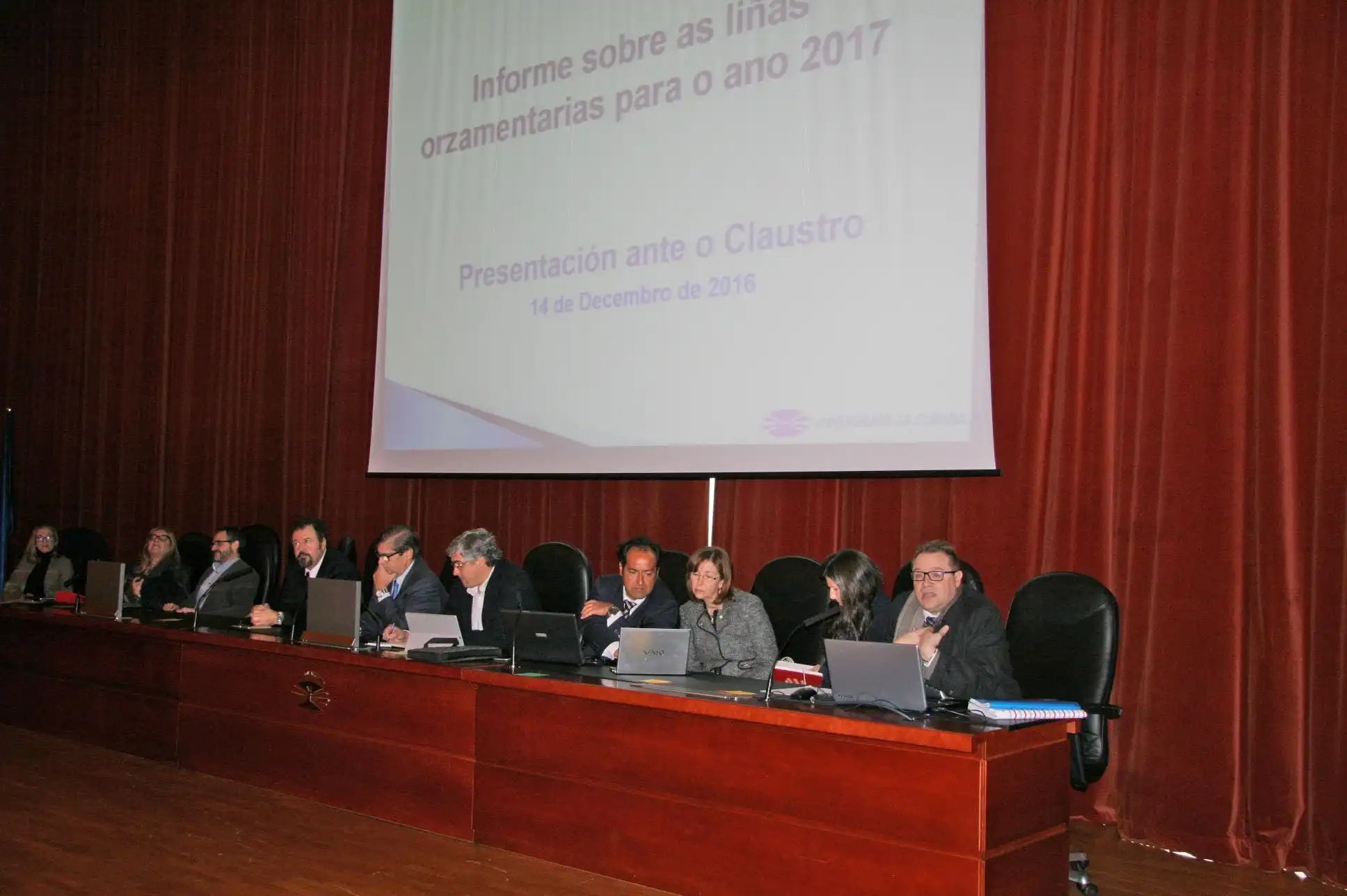
A Coruña, December 14, 2016.- The Reitor of the University of Coruña, Julio Abalde, presided this morning at the Senate session in which the Xerais Orzamentarias Lines for 2017 were presented, which amount to 119.4 million euros for the next fiscal year, 2.64% more than the previous one, and which were approved with 68 votes in favor, 8 against and 20 abstentions.
The Vice-Chancellor of Economy, Infrastructure and Sustainability, Domingo Calvo, explained that the increase in funds comes on the one hand, due to the recovery of the specific complement attributable to the extra pay of workers and on the other hand, due to the improvement of two indicators associated with the results fund: These indicators at the University of Coruña have led to a significant increase, or better behavior of the Galician University System. “This is new for the University of Coruña. We have improvements in academic performance, in research and transfer of research results,” explained the vice-reitor to conclude that “we are more efficient.”
With questions about the Xerais Orzamentarias Lines, Professor Andrés de Blas asked that the documentation from this point of the Cloister be sent before the cloistered years or that it was replied that the negotiations with the Xunta on the last day, or December 9, made it impossible to access the documentation more in advance; There is documentation, on the other hand, that is not included in any regulations that must be presented. Professor Luis Castedo intervened to point out that there is a lack of reference to the Strategic Plan of the UDC in the Orzamentarias Lines as well as agreed with the vice-chancellor that “it is good news for the UDC” to improve two indicators for results and the increase in financing achieved in this way.
Xosé Portela, representing the administration and services staff, stated that the document contains “a proliferation of data regarding the administration but that it is more vague with respect to the intentions of the government team regarding the preservation of the teaching staff and administration and services personnel” and the request of the prosecutor would continue with the perseverance of two previous teams in not maintaining the personnel. Likewise, they demand the recovery of social action cut in recent years. Professor Anxo Calvo, on his part, made a reading of two orzaments linked to the work action of two previous teams and sublined that the rigorous economic management initiated is “beginning to give results.” I agreed with Castedo in demanding two objectives of the Strategic Plan and approving the investment effort in personnel “where the intellectual capital is and what cannot be waived.” The professor at the Faculty of Economics and Business also indicated that this provision with a surplus and lack of debt from the UDC means “continuing compliance with the Law on Organizational Stability.” Lembrou also believes that the second or last study given by Fundación CyD, to UDC, is more efficient in the Galician University System.
Professor Amalia Blanco encouraged the vice-reitor to persevere before the Xunta de Galicia to provide the economic data to be able to prepare the organizational accounts with sufficient time because “something has been established or the new University Financing Plan of the Galician University System is that the economic accounts available to the universities should be prepared with sufficient time so that they can carry out their calculations in time.” Finally, the interventions at this point concluded at the request of Professor Carlos Platas for a future projection of the behavior of two results indicators.
The director explained that the economic accounts of the UDC, after the Cloister process, will go to the favorable report of the Government Council on the 22nd, or the same day on which they will be submitted for approval by the Social Council so that they come into force on January 1, 2017. He explained that the document itself is exposed to the government priorities for the next year that they spend on the stabilization and maintenance of the faculty and staff of administration and services, to internationalization and to continue working on efficiency, with measures such as the direct purchase of energy that can involve up to 25% capacity. Abalde put on the table the concern about the decrease in students who are living in the Galician University System, which went from 64,538 students during the 2013/2014 academic year to 60,830 during the 2014/2015 academic year. This decline is parallel, said the reitor, to the Galician demographic decline. Not with regard to the results indicators, the entire University of Coruña has been congratulated for its achieved success, warning that these indicators are not favorable for the UDC and this is what they have expressed on repeated occasions before the Xunta. “Some indicators were put forward that were difficult to meet and those that made the UDC stronger were removed, such as the job placement of two graduates,” he explained, deceivingly saying that “we are improving more than other Galician universities but we have to improve even more because the indicators hinder the progress of the UDC.” At this point, the Vice-Chancellor of Economy specifies that two of the most important indicators have to do with attracting talent and that the UDC launched the InTalent program, financed by Inditex, to retain and attract talent but that its results will not be reflected in economic terms for the year 2019.
The day’s agenda included the presentation of the Report by the University Supporter, Enrique Ansemil, who explained that in the last year the number of cases had decreased, attending to a total of 80 consultations and 35 queries, mostly from the group of students regarding access, taxes and academic management. In the next series of interventions opened at this point, I took the opportunity to address several topics with specific reference to Valedor’s report, such as part-time enrollment regulations or Aneca’s new regulations on the requirements for teacher accreditation to be able to promote what Professor Moisés Canle assured, as a result of which university talent left Spain to pursue their professional career. Student Alberto Franco agreed with what the speaker expressed about the decline in university students and demographics, but also pointed out “that the drop in enrollment is linked to expulsion for economic reasons from the university.”
The Cloister marked on the order of the day a last open round of interventions in which professors Alejandro Pazos and Santiago Roura expressed their opposition to the Infrastructure Reorganization Plan of the UDC with the cloister Xosé Portela who recalled that an extraordinary Cloister was convened to discuss this point. “I feel that the reflections argued here were not made in the Senate expressly convened for this matter,” he stated. With the intervention of student Alberto Franco demanding improvements for this group such as lower prices for the university bus or the university residence to attend a session.
Publicado por:
Gabinete de comunicación