


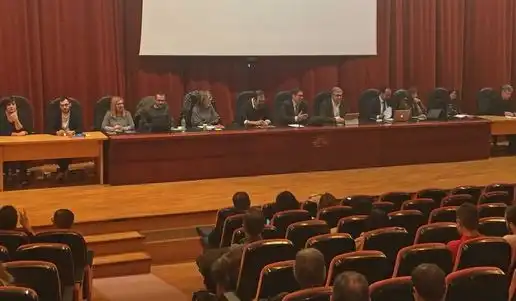
A Coruña, December 12, 2017.- The Vice-Chancellor for Economy, Infrastructure and Sustainability, Domingo Calvo Dopico, presented this morning in the Senate the general budget lines for 2018, and an estimate for 2019, which were approved without any votes against, 57 votes in favor and 26 abstentions.
The budget of the University of A Coruña for next year stands at 123.295 million euros, which represents an increase of 3.22% with respect to 2017. “Next year’s financial year presents a scenario in which a slight increase in income is occurring but – warned the Vice-Chancellor for Economy – the UDC continues in a restrictive economic context, since the budget is still below the levels prior to the economic crisis which stood at 137.8M€ in 2009”. “This requires us to contain the level of current spending and not be able to carry out important capital investment actions,” declared Calvo Dopico.
It is worth noting, according to the Rector, Julio Abalde, that “the UDC remains debt-free due to rigorous management of its economy even in the worst of times”.
The main source of funding for Galician Universities is contributions from the Autonomous Community, which represents approximately 80% of the budgets. The remaining contributions come from public fees or prices and property income, raising research funds through regional, national or European projects; other contributions from private companies, and the remainder.
Within the contributions from the Autonomous Community, a distinction is made between a structural fund and a results fund. The standard cost, -the most important part of the structural fund and which represents the most important contribution since it is the one that responds to teaching and functional needs-, is undergoing a notable change. This fund used to evolve directly based on the number of students but now varies based on the credits enrolled. The University of A Coruña improves its relative importance in the structural fund from 26.8% to 28.02%, which represents a standard cost of €70.14M, and which represents an increase of €3.76 million. To this standard cost fund, we must add, in the special case of the UDC, an additional improvement in structural funding of €1.4 million as compensation for the underfunding experienced in the previous Financing Plan between 2010 and 2015, as a result of the demand for the contentious-administrative appeal filed by the UDC. The University of A Coruña will receive €4.2M in total, in the years 2018, 2019 and 2020.
The results fund is mainly made up of two sub-funds: remuneration supplements and tuition compensation, and the indicator panel. The indicator panel, in which 63.52 million euros are distributed, is distributed competitively based on indicators of teaching, research or transfer capacity. The UDC improves its weighting in both the remuneration supplements sub-fund and the indicator panel. The data indicate that the University, as a whole, is improving the performance of research and transfer activity. The UDC’s surplus has been experiencing a loss in recent years due to the budgetary context of financial restriction, but with the rigorous management of the UDC, the surplus in 2018 is 0.589M€, which represents an increase of 20%.
In the expenditure chapter, personnel expenses increase by 2.11%, which represents 74.78% of the budget, reaching an amount of €92.201M. Real investments decrease by 9.78%, although they may increase significantly this year from contributions from the Research, Development and Innovation Fund of the Autonomous Community in the form of quality improvement and promotion and support programs for research and transfer. With respect to current expenses and current transfers, there is a notable increase in both cases. A budget projection for 2019 of €126.613 million is made, which would represent an increase of 2.69%, but this variation will depend on other indicators such as the evolution of the GDP of the autonomous community, the evolution of credits enrolled in the Galician University System or the evolution of the economic module that largely determines the volume of current transfers made by the Xunta de Galicia to finance teaching or functional needs.
Finally, the big news for 2018 will be the launch of the Specialization Campuses for A Coruña, the Innova Campus and the Sustainability Campus. The aim is to advance in defining the major areas and lines of specialization for the University on which both the lines of research or transfer and the areas of training or academic interest are specified. Through these Campuses, the attempt is made to provide a better academic offer and improve the transfer of knowledge to society.
The UDC budget will be presented in detail at the next session of the Governing Council, on Wednesday, December 20, and will have to be approved by the Social Council for it to come into force.
At today’s Senate session, the rector reported on the status of the new degree map and the specialization process of the A Coruña campuses, after the Ferrol campus specialized as an Industrial Campus. Abalde expressly thanked the excellent work of the director of the Ferrol Industrial Campus, Ginés Nicolás, and the entire team for the good results they are achieving.
The Rector also reported on the stabilization and promotion policy for teaching staff, which will allow the new year to begin without any pending stabilization process, after ending in 2017 with all the pending stabilization and promotion commitments since the replacement rate came into force in 2012. He also reported on two new additions of researchers to the UDC-Inditex talent recruitment program, the InTalent Program, as a result of the second call in which 64 applications were submitted from all over the world and which will allow two new researcher appointments to be added to the UDC in January. Abalde said that the renewal of the strategic grouping of the CICA and INIBIC research centers, of which the UDC and SERGAS are part, has also just been granted; and a fund of 190,000 euros from Mineco so that the OTRI can help UDC researchers participate in calls for European projects and international networks.
Posted by:
Communication cabinet