


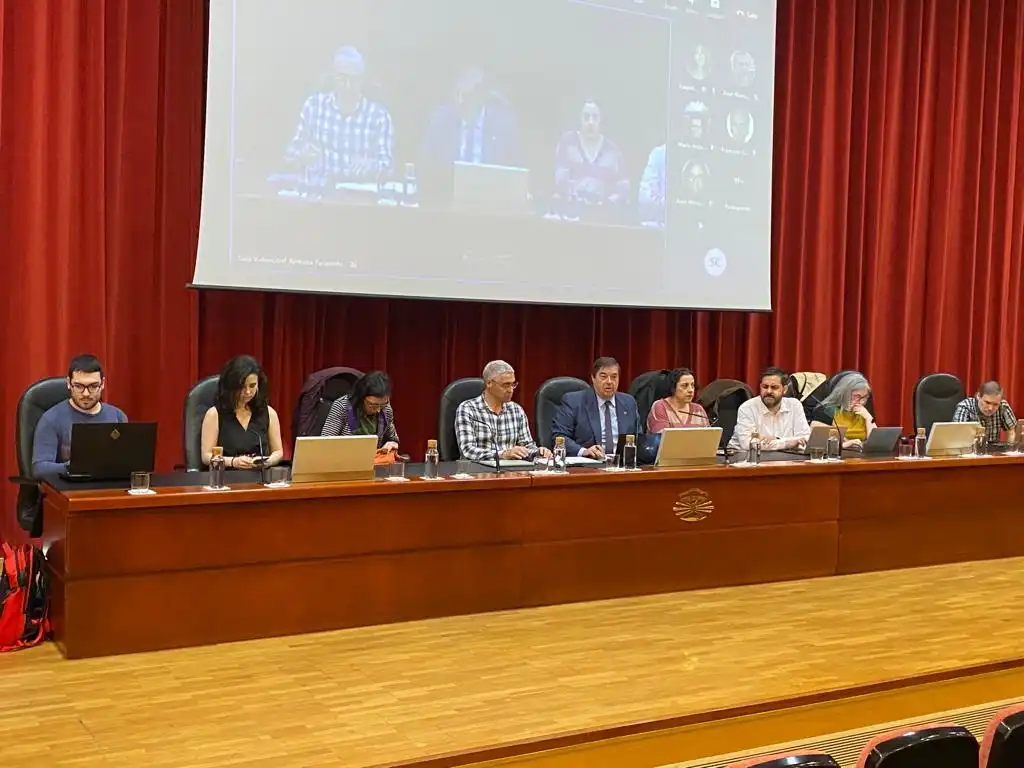
A Coruña, May 5, 2023.- The Senate of the University of A Coruña approved this morning the management of the Rector, Julio Abalde, for the year 2022 with 68 votes in favor, 12 abstentions and two votes against.
This was the eighth Management Report presented by Rector Abalde, who took the opportunity, at the end of the session, to thank the faculty “for their complicity in these eight years in which there has always been collaboration and joint work to improve the University of A Coruña.”
The Rector gave a detailed account of the activities carried out by the UDC government team last year with a long speech that we summarize with this introduction:
“The year 2022 finally allowed us to recover the desired normality of university life, and it even began by offering us the opportunity to celebrate the awarding of the honor “Ferrolán of the Year” by the Ferrol City Council to the UDC Industrial Campus. This recognition is a confirmation of several years of work for the revitalization of a campus that is now becoming a benchmark.
The creation of the Ferrol Polytechnic School of Engineering, which houses all the teaching taught in the former Polytechnic University School and the Polytechnic Higher School, was a milestone for the campus. We are convinced, in view of the results, that the EPEF is destined to become the reference center for engineering in Galicia and that it will be enhanced with the future Building for Research and Innovation in Industry (EI3) initiated last year with an agreement with the Ministry of Culture, Education, Vocational Training and Universities, for which the Xunta de Galicia is financing the development of the building project with around one million euros.
Despite the expectations of the end of the pandemic, its effects were still felt and forced us to cancel the celebration of University Day for the second consecutive year. This festival is a tribute to students and it was a pity not to be able to celebrate with our students and their families this recognition of their efforts in unprecedented conditions.
Without a doubt, the recovery of normality in all areas of our lives was encouraging at the beginning of the year, when the world was shaken by the beginning of the Russian invasion of Ukraine, in February 2022. Like the rest of society, we were deeply affected and immediately made ourselves available to help and alleviate, to the best of our ability, the tragic effects of this war. Thus, we prepared an aid plan so that university students from Ukraine could continue their studies at our university.
As the conflict continued, its multiple effects became more acute, and we were forced to take extraordinary measures to deal with the high prices, mainly in terms of the supply of energy and, in some cases, of different materials, suffering the slowdown of some projects.
Throughout 2022 we have been working on the design of the 2022-2026 Strategic Plan for which we have had the participation of more than 120 people from the university community in the collective preparation of this document, which was approved by the university Senate at the beginning of November. It will be a very valuable roadmap to better position the University of A Coruña in its sphere of influence, within the framework of the SUG and the SUE and in the international context.
We have a new Galician Financing Plan for the SUG 2022-2026, signed in February, which improves its structural part compared to the previous ones. We are working hard to see this demand recognized in this new framework which is, on the other hand, more demanding than others, by financially penalizing the non-compliance with some criteria.
Once again, the University of A Coruña presented healthy accounts, with a budget increased this year by 7.98%. We maintained our commitment to equal opportunities for students, by investing in actions already consolidated at the UDC in terms of scholarships, awards, programs, residencies, etc., with a total budget of 2.5 million euros. We increased our relationships with the main productive sectors of the country and intensified institutional synergies by adding collaboration agreements in very different subjects. It is worth highlighting the sponsorship agreement signed with the CEO of Inditex, a UDC alumni, Óscar García Maceiras, for an amount of 1.5 million euros to attract excellent research staff with the InTalent program and also the creation of the UDC-Navantia Joint Research Center (CEMI) “The Shipyard of the Future”.
In terms of talent recruitment, 2022 marked a milestone with the addition of six new Ramón y Cajal researchers, bringing the total number of active researchers to 16 thanks to this programme. Undoubtedly, the “HR Excellence in Research” seal from Human Resources Strategy for Researchers, HRS4R, which accredits good practices in the recruitment of research staff, which the UDC was able to renew last year, had something to do with this success.
The establishment of the strategic international university consortium EMERGE (European Margins Engaging for Regional and Global Empowerment) is also a considerable achievement for this university, which places us at a higher level of European quality.
This alliance of European universities is made up of universities from France, Ireland, Greece, Germany, Norway, Slovakia, Cyprus and Spain, with the UDC.
The year 2022 is also marked by a milestone, external to the University of A Coruña in a way, but which will have a more than significant impact on our future as an institution. At the beginning of December, the Council of Ministers chose the city of A Coruña as the headquarters of the Spanish Agency for the Supervision of Artificial Intelligence (AESIA). The Government highlighted the “important university ecosystem of A Coruña, both in training and research related to Artificial Intelligence, as well as the excellent business ecosystem with up to two digital innovation hubs that generate 10% of Galician employment”.
As is known, the AESIA candidacy passed a Galician selection process in which the UDC was decisive in promoting and defending the A Coruña headquarters.
The ICT City project, in 2022, became a reality with the start of work on the Galaxy Lab, the drone laboratory of the Galician Technological Institute (ITG) and the Advanced Services Center (CSA), which we will inaugurate in 2023.
The return to normality, as detailed in the different areas covered in this report, has filled the campuses with activities and initiatives in the most varied formats, such as the exhibition projects of our NORMAL Cultural Intervention Space. The exhibition “A Galicia deseñada” set a record of attendance and impact as it was the first exhibition in the history of Galician design.
In the area of social responsibility, the UDC has been recognized for its commitment to the values of educational inclusion by being awarded the title of Shared Space Program with the VIII Diversity Foundation Award, in the category of public institution. I also congratulate our teaching staff who this past year saw their research work recognized with national and international awards and distinctions or with their incorporation into different academies. The merit is undoubtedly personal but the recognition exerts its influence on the entire University of A Coruña”.
Report of the University Ombudsman
In addition to the Rector’s management report from last year, the University Ombudsman, Ana Tarrío, reported on her activity in the 2021/2022 academic year. In that period, there were a total of 159 cases, divided into 99 consultations and 60 complaints.
Of the 99 queries submitted by the three groups of the UDC, the majority correspond to students (85%), followed by teaching staff (8%) and people outside the university (7%). The number of queries decreased with respect to the academic year in four cases. The largest number of queries was made on the subject of exams and evaluation criteria, followed by queries related to teaching activity.
In the 2021/22 academic year, 60 cases corresponding to complaints and claims were recorded, with a decrease of nine compared to the previous year. The majority of cases correspond to students (62%), followed by teaching staff (18%), administration and service staff (12%) and people outside the university (12%). The largest number of cases cover the topics of organization and teaching activity; access, fees and academic management, and infrastructure and operation of services.
Posted by:
UDC Communication Office