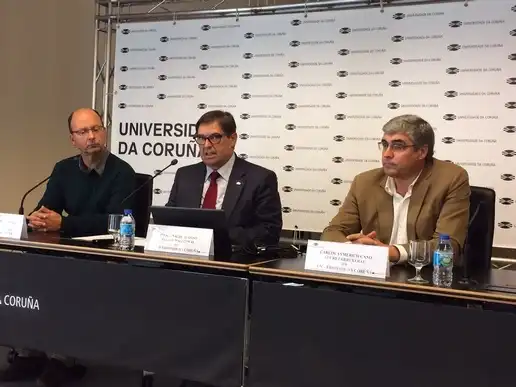
A Coruña, October 26, 2016.- The Governing Council of the University of Coruña approved this morning, in its ordinary session, the Proposal for the rationalization of academic structures of the UDC, by 28 votes in
favor, 11 against, 1 blank and 2 null, in a secret vote at the request of six two members of the Council.
The vote was preceded by a long debate in which there were 18 interventions “all constructive and with a proactive attitude”, according to the deputy leader, Julio Abalde, in the press release after the government
session. Abalde expressed his “gratitude to all the faculty and administration and service staff for the completion of a restructuring process of this magnitude that has never been done.” “The University of Coruña
has a modern, flexible and more efficient structure to face future challenges in better conditions,” said the Rector.
The proposal that is approved this morning supposes a reduction of 13 Vice-Rector or deputy directors of centers and the abolition of departments that go from 43 to 26. These measures will have economic effects
that are quantified in a direct funding of 157,000 euros plus another 400,000 euros of indirect costs due to the elimination of the reduction of the teaching load. professors who held the suppressed positions. This
process, which began in May 2015, is not, as General Secretary Carlos Aymerich said, “a full stop without a full stop because adaptation to a changing environment is a continuous process.” Aymerich explained to
the media that the changes will be effective in the following elections of centers and departments that will be called before the end of the year, with the update expected to be completed by the first quarter of 2017.
The proposal to rationalize the academic structures of the UDC was a dialogue and consensus process with all the groups involved from the approval by the Government Council of July 2015 of the procedure to be
followed. This procedure was not included or debated in the Senate that took place this same month and was convened by express decision of the government team chaired by Julio Abalde. In this sense, the Rector
emphasized that “we acted with transparency, information and dialogue with meetings with all those who thus requested the incorporation of the majority of amendments presented in the various periods that were
opened for this purpose.” The Rector commented that on Tuesday, October 25, he received a request from the UDC Records on the Ferrol Campus, made by four professors, a member of the Governing Council,
requesting the withdrawal of the Proposal from the agenda of the current Governing Council session.
In this regard, Abalde stated that "those who worked in this process did not deserve to be withdrawn from the agenda due to an untimely request, without more argument than debate at the university." “It's a
wonder that the Senate in which the ideas of the university community on this topic were contrasted and that some modifications to the text were accepted were not said or that they were said in a press release
several days later,” lamented the Rector, alluding to a press release called by these four professors last Monday in which the process was criticized.
The proposal for the rationalization of academic structures of the UDC is the work of the Study Commission for the Plan for the Rationalization of Academic Structures, CEPREA, chaired by the Vice-Chancellor of
Teaching Staff and Teaching Planning, Alberto Valderruten, in which were the Vice-Chancellor of Economy, Infrastructure and Sustainability, Domingo Calvo, and the General Secretary, Carlos Aymerich, and all of
them. Deans and directors of centers, representatives of administration staff and services and students, as well as some department directors with voice but without vote, a composition also approved by the
Governing Council. The objective of restructuring is to improve teaching, or to promote the transfer of knowledge and research and to achieve a more efficient, flexible and flexible administrative structure. This Plan
represents the first major reform of the UDC's structure in its 27th year of existence. The UDC has 22 university centers of its own and 3 affiliated, with the majority two schools having less than 500 students
compared to others with more than 2,000. The Plan proposes objective criteria so that the composition of two six management teams is proportional to sex.
With regard to the other points on the agenda of the Governing Council, Abalde reported at the summary session of the agreement reached with the company Inditex to launch the InTalent program that will allow
the hiring of researchers of international relevance. The issue of university access was also discussed, which is of concern and that work is being done jointly with other Galician universities and with the Xunta, and
the next call for recruitment of several teaching positions for various teaching needs.