


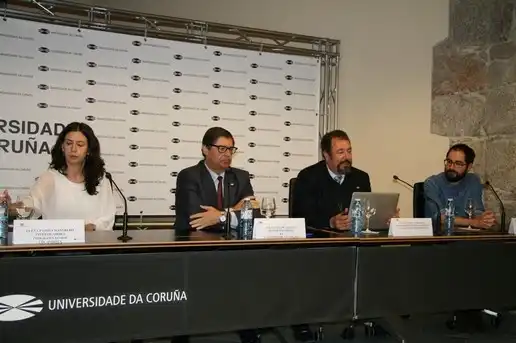
A Coruña, April 17, 2017.- The Rector of the University of Coruña, Julio Abalde, and the Vice-Rector of Scientific Policy, Research and Transfer, Salvador Naya, presented this morning in the Presidency the two new internationally renowned researchers who are joining the A Coruña academic entity within the InTalent UDC-Inditex Talent Acquisition Program.
Elena Pazos Chantrero and José Antonio Cortés Vázquez were selected by a commission of experts from a total of 122 applications received from 21 countries in Europe, Asia, Africa and America to participate in this first call of the InTalent program.
The Rector reiterates thanks to the company Inditex for its support for this program where we are beginning to see the first fruits. He emphasized that the two selected researchers have brilliant curriculum and highlighted that in the case of Elena Pazos it is about a return to the autonomous community in which she was formed, since she was at the Chemical Technology Center of Catalonia; While the case of José Antonio Cortés is a demonstration of talent recruitment. Abalde regrets “that only two researchers could be selected because the quality of the applications for the level of the two new researchers that we have and indicates an absence of channels to give a stable research career to these researchers who are trained and foreign and who have no way to join Spanish centers and universities.” This same international trajectory of two selected researchers was highlighted by Vice-Chancellor Salvador Naya, who highlighted the extensive experience of the two researchers despite being two new people. For her band, Elena Pazos thanks UDC for this call. “The UDC is making a very important commitment to research, which is not usual in our country, unfortunately, for new researchers like us.” José Antonio Cortés also offered words of gratitude to the University of Coruña “to support the research of new people who wanted to return abroad”, or his last contract was at the University of Sheffield, and announced that this program will allow them to compete in calls for European projects of maximum prestige.
Elena Pazos Chantrero (Marín) taught at the University of Santiago de Compostela in 2012 under the supervision of two professors José Luís Mascareñas and M. Eugenio Vázquez, working on the synthesis of fluorescent sensors for the detection of some proteins involved in cancer. During his teaching period he was a visiting student at Trinity College Dublin (Ireland) and the University of Illinois in Urbana-Champaign (United States). Upon completion of his doctorate, he received a postdoctoral fellowship from the Barrié Foundation that allowed him to join Professor Samuel I. Stupp’s group at Northwestern University in the United States, where he carried out research in the fields of supramolecular chemistry and bionanotechnology. After her postdoctoral stage, she worked in the spin-off Medcom Advance as a researcher for a year, and in December 2015 she joined the group of Professor Ramón Álvarez Puebla at the Centro Tecnolóxico da Química de Catalunya as a TECNIOspring and Marie Curie researcher. Throughout her research career she published fifteen scientific articles, most of them in high-impact journals in the field of chemistry, and some two results of her research were protected with two patents.
Project: The research project that Elena Pazos will carry out at the Center for Advanced Scientific Research (CICA) of the University of Coruña during the next few years will have the same multidisciplinary nature that characterizes her research career, and will be focused on the development of chemical tools with applications in biomedicine.
On the one hand, intelligent sensors for degenerative diseases will be developed, that is, molecules that, in the presence of specific markers for these diseases, emit light, thus allowing their detection. These sensors could not only be used for early diagnosis, but also to understand at a molecular level the mechanisms that cause pathology and as powerful tools to identify new therapeutic targets and new drugs. On the other hand, work will also be done on the development of new biocompatible nanomaterials capable of producing a certain effect on cells, such as promoting cellular regeneration or using them as vehicles for the controlled administration of drugs.
José Antonio Cortés Vázquez (Seville) has a degree in Environmental Sciences and a PhD in Social Anthropology from the Pablo de Olavide University (Seville). Their research focuses on the analysis of the relationship that human beings maintain with the environment, from the point of view of culture and political ecology, through the study of rural and coastal communities in protected natural spaces. He worked as a Marie Curie postdoctoral researcher at the universities of Manchester and Sheffield and as a professor at University College London and the National University of Ireland-Galway. He coordinated international conferences and projects and published more than a dozen chapters and articles in internationally prestigious magazines, as well as a monograph on poetry that he received in 2011, the Marqués de Lozoya national award, or recognition of greater prestige in social anthropology in Spain.
Project: Cortés Vázquez studies the benefits and social impacts of environmental conservation policies in post-crisis Europe: The Galician case, and will develop his project at the Faculty of Sociology.
The expansion of environmental conservation policies in recent decades has been accompanied by important social changes in the rural and coastal world. Since the 1980s, the complexity of considering a more sustainable use of natural resources meant that in many cases the introduction of environmental conservation policies led to conflicts with local populations. On the other hand, it also opened the door to new forms of economic development through activities such as ecotourism. However, the economic crisis and the introduction of austerity policies over the last decade have greatly reduced the resources and action capacity of environmental management. On the other hand, it also encourages the participation of new sectors of civil society and the private sector in conservation policies. With this xerouse a new scenario within two protected natural spaces on which we need to reflect.
In light of these recent changes, this project seeks to identify and analyze what both the benefits and the social problems are being eroded by new environmental conservation strategies that are seen considering the present post-crisis context. Through a detailed study between rural and coastal communities in different protected natural areas of Galicia, the objective of this work is to identify how the communities that inhabit these protected areas are facing the economic crisis and the link between their present situation and the conservation measures proposed in these areas. This project aims to incorporate a more social vision into conservation policies and contribute from the social sciences to general reflection on a more responsible use of natural resources.
InTalent is a program to capture and retain research excellence in Galicia. Created by the University of Coruña in 2016, it has funding from Inditex for a total amount of 1,450,000 euros to hire six researchers, who will join in two years 2017, 2018 and 2019. The contract will have a duration of two years, with the possibility of extension for another year.
Published by:
Communications Office