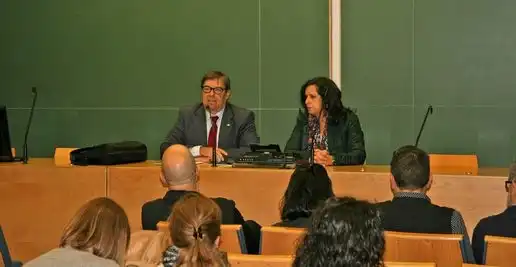
A Coruña, November 16, 2016.- The Rector of the University of A Coruña, Julio Abalde, began last Friday the round of visits to all university centers with a meeting at the Higher Technical School of Architecture,
where the Vice-Rector for Academic Offer and Teaching Innovation, Nancy Vázquez, also attended. With a notable attendance of professors, administration and services staff and students, during the more than two
hours that the meeting lasted, all kinds of topics of interest to the School of Architecture were discussed.
The event began with a reflection by the Rector on the current situation of the University of A Coruña and the challenges that arise for this academic year. According to the Rector, “this is the time to stop and think
about the results of the Bologna process from the point of view of the training content that we are teaching and the skills and abilities that our students are acquiring”. Abalde explained that this academic year marks
the end of a cycle when all the degrees are accredited and that it is therefore a good time to reflect on the future and decide among all “the University of A Coruña that we want to be”.
In the state of the university issue, the financing had a chapter by the Rector, who explained the difficulties of the current Financing Plan of the University System of Galicia that does not benefit the UDC, and that he
will try to explain to the people in charge of the Xunta de Galicia. Despite this, Abalde glimpsed some improvements in the collection of resources that represent a significant increase in income from companies and
other public institutions, such as the fund provided by the company Inditex for the InTalent project, or various contributions from the City Council of A Coruña and the Provincial Council of A Coruña.
On the economic issue, there were several interventions in which greater investment in infrastructure was requested at ETSAC, to which the Rector replied that the budget dedicated to works at the UDC is only
800,000 euros in total, so important and necessary works cannot be undertaken and it is only enough to make urgent repairs. For the same reason, he added to questions from attendees, investments cannot be
made to renew technology either, which has to be done little by little. One of the improvements undertaken to alleviate the renewal process is the implementation of virtual desktops that extend the useful life of
computer equipment by only having to update the servers on which they are hosted.
Academic issues had an important weight in this meeting between the governing team and the university community of Architecture, since this center teaches a unique degree with its own curricular characteristics
and the application of generic standards causes some organizational dysfunction.
The students, in this sense, raised many doubts, many of which were answered by the Rector and the Vice-Rector for Academic Offer and Teaching Innovation, but in others Nancy Vázquez committed to holding a
specific meeting to hear the students' suggestions and see if they could be resolved within the University's competences, since some of them, such as tuition prices, are not the competence of the UDC.
The situation of the new Degree in Landscape, which is being worked on jointly with the University of Santiago de Compostela, and in which the School of Architecture is leading the process of its future
implementation, was discussed. Regarding new degrees for the University, the Rector commented that the path first involves specializing the UDC in an area in which it has strengths, to which the ETSAC professors
pointed out that the idea of territory and city should be taken into account.
Another of the topics discussed was the incorporation of new students. The general decline in new students in Galicia is conditioned by demographic curves. If in 2002 there were 19,000 students in the Galician
University Entrance Exams, this year the number was 11,000 students. To this must be added the economic crisis linked to the construction sector.
Finally, another of the major issues discussed in this meeting was the recruitment and promotion of teaching staff. The existing replacement rate, the Rector reflected, leads to the dichotomy of stabilization or
promotion. On this question, the Rector assured, the commitment of his government team "is to stabilize".
Finally, one of the professors, who thanked the Rector for his presence at the center, asked for explanations about the process of merging the departments, which was explained in detail by the Rector.