


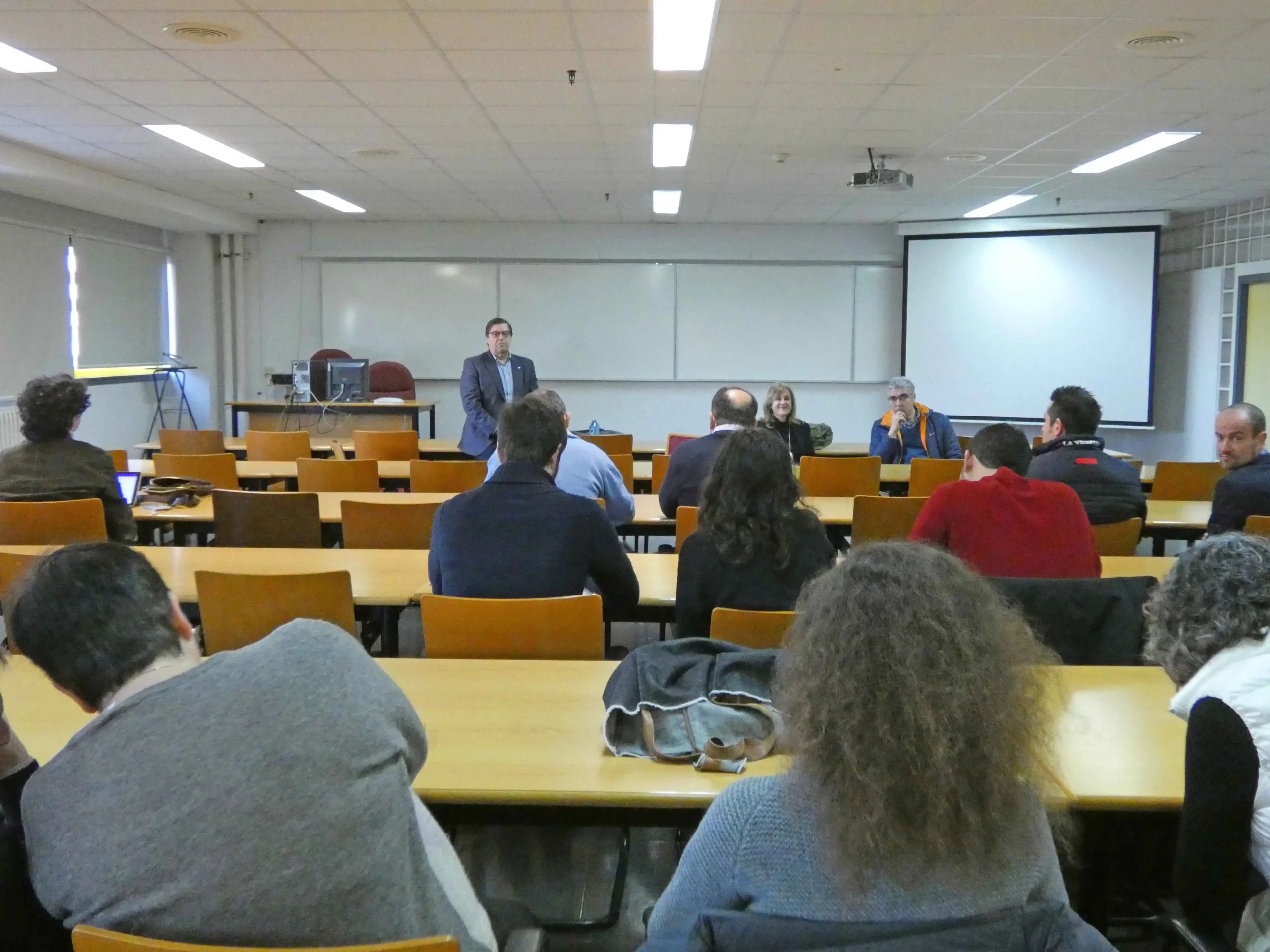
A Coruña, February 13, 2019.- The Rector of the University of A Coruña, Julio Abalde, began his program of visits to each of the university centers last Monday with a meeting with the community of the Higher Technical School of Road, Canal and Port Engineering, where he attended with the Vice-Rector for Internationalization and Cooperation, Pilar García de la Torre, and the Secretary General, Carlos Aymerich.
These meetings, open to students, faculty, and administrative and service staff from each center, have been organized every academic year and aim to exchange impressions and share concerns about current university events. Abalde outlined the context of the conversation with a brief presentation on the current situation of the University of A Coruña, which has just completed its specialization with the launch of the Innova Campus and the Sustainability Campus, to which must be added the Ferrol Industrial Campus. The specialization of the campuses was a process that culminated in a period of work on internal analysis of the UDC’s potential in teaching and research, which was joined by the decision to promote research and the internationalization of the university, as well as the transfer of knowledge to the business sector.
This process continues with the remodeling of the degrees “to anticipate what the professions of the future will be”, defined the Rector. This year, the Degree in Fashion Industrial Management has already been implemented, the first multilingual in English in the Galician University System – with 40% of the subjects in English-; and the Degree in Landscape together with the University of Santiago de Compostela, the first interuniversity in the Galician University System. This new offer, together with which the degrees in Data Science and Engineering; Digital Creation, Animation and Video Games; Information Management and Digital Documentation and the Dual degree in Electrical Engineering will be implemented next year, “the UDC shows its capacity for new and risky proposals that indicate its potential”, indicated the Rector.
In addition to the training panorama, Abalde gave some hints about the economic situation. This government team released, when it took office, a financing plan that was always argued to be harmful to the UDC, so a process was initiated to demonstrate the unfairness of that plan, with very laborious negotiations but which concluded with the demonstration of a failure in the basis of the calculations and with the ratification in the courts that the UDC is underfunded. However, the Rector acknowledged, being now in a better situation “we are still underfunded”. Throughout this time of economic uncertainty, the UDC defended two priorities: the maintenance of the staff and student aid. “We were the first Galician university to create a specific fund for student aid with economic problems”, he pointed out. Maintaining these priorities meant that all the other items were drastically reduced. This year, the budgets are around 129 million euros, of which 96 are for the personnel chapter, which accounts for the reduced room for maneuver.
Promotion and stabilization of teaching staff
In the round of open interventions, the school’s director, Ignasi Colominas, intervened, asking the Rector’s opinion on the integrated programs between bachelor’s and master’s degrees, as well as to know the forecasts of the promotion and stabilization plans for the teaching staff. Abalde defended, as he had already done in his time as director of the Quality Agency of the Galician University System, that in the case of degrees with professional skills in master’s degrees there should be continuity, an integration between bachelor’s and master’s degrees and encouraged the center to propose it.
The situation of the teaching staff is a concern, the Rector acknowledged, for most universities resulting from the imposition of a 10% replacement rate a few years ago. This has meant “an impoverishment of the staff as new teaching staff are not entering, and a teacher cannot be improvised”. The UDC, within the Galician panorama, is the university with the youngest staff, the result of a “sound teaching staff policy” that prioritized the stabilization of doctoral assistants and, in the last two years, promotion positions have also been offered. The forecast is that this year positions will be called for those accredited until 2016 and also for all assistants who finish in 2019. The Rector explained the responsibility for creating the positions. “The moment a doctoral assistant position is created, an academic trajectory is created and we have to be rigorous to guarantee that person a professional career at the university”, he declared. He also announced that a program will be created to incorporate teaching staff who do not have a stable contract and are accredited as tenured, as well as another access route for Marie Curie, ERC, InTalent, etc. researchers.
ICT City
One of the students present asked the Rector about the project called Cidade das TIC and how it would affect the School, he also expressed his concerns about the financing of this project which should not bring, he defended, “debt for the UDC”. The Rector assured that the Cidade das TIC “cannot cost the UDC a single euro”. Abalde explained that this project of the UDC and the Galician ICT Cluster will mean that the university will be close to companies with a transversal capacity and that it could be of great interest to the Escola de Camiños, for example, in matters of logistics. “In the project that we present, we want this common space of companies and the university to be an example of ICT technology and innovation, but we also want to be an example of sustainability and energy use and in these aspects, this center has a lot to contribute”, he assured.
One of the professors intervened to regret that the teaching staff of this center are not in the “hard core” of the coordination groups of the Innovation and Sustainability specialization campuses that are defining new degrees. Abalde expressed his satisfaction with this comment because “this center has different undergraduate and master’s degree potentials than those already being taught at the school” and assured that all those who are interested will be able to participate in the new proposals.
Finally, one of the students revealed his concern about the enrollment figures in the degrees in the construction area and provided data on the number of students in the degrees in this field. The Rector agreed with this concern. “We are suffering the consequences of the crisis in the construction sector in the related degrees”, he said, adding that from the Rectory they promote campaigns to disseminate all the degrees but it must be the centers that lead the specific initiatives. In this sense, he gave as an example the work that they are doing from the Ferrol Industrial Campus with the promotion and dynamization of the engineering that are recovering students.
Posted by:
UDC Communication Office