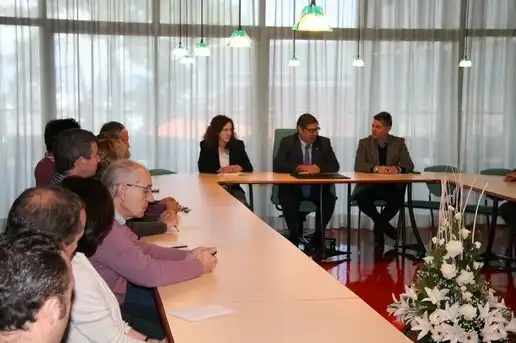


A Coruña, December 1, 2016.- The Rector of the University of Coruña, Julio Abalde, and the Vice-Rector of Students, Participation and University Extension, Margarita Amor, met on November 22 with the university
community of the Higher Technical School of Technical Architecture, within the round of visits that will be held in all the UDC centers.
The meeting began with an explanation by the director of two challenges that he considers must be faced by UDC this year and that are the review and analysis of the implementation process of two Bologna degrees
and the specialization of the Coruña Campus, which was established at the Ferrol Industrial Campus. In addition, Abalde reported on the new InTalent UDC-Inditex program, to recruit international and reference
researchers to develop their research project at the University of Coruña.
The director of the School, Pedro Nogueira, opened the round of interventions coinciding with the presentation by the director. In the line of specialization, the director pointed out that the area would have to be
related to habitat, or contour and building, points that UDC has little potential for. In addition, we transfer to the director the interest of the students of this center to incorporate into their teaching methodology or
collaborative work and technological tools. Abalde admitted the importance of technological areas in the UDC with centers such as the School itself, Architecture, Civil Engineering, and the Polytechnics but misled
that specialization has to be multidisciplinary and or as open as possible, also incorporating other aspects such as sustainability, environment, energy efficiency, etc.
Regarding the incorporation of new teaching methodologies, the availability of the University Center for Educational Training and Innovation (CUFIE) is open to specific proposals made by the centers. Asked about
the stabilization of the teaching staff, the Rector insisted that as a government team “we are committed to stabilizing the teaching staff in the structural positions.”
One of the two topics that several people present brought up on the table was the loss of attractiveness of degrees related to construction in line with the crisis situation in the sector. “This profession has roots in
Spain and we have gone through several crises and what we see now, with a decrease in students, is that in the middle period there will be a lack of Technical Architecture professionals,” said two teachers. The
director encouraged us to be proactive in this difficult situation and to carry out a “powerful methodological rearrangement” to continue being a reference center at the national level. In this academic line, two
professors proposed promoting the incorporation of students from Vocational Training, giving more information to the list of validations between degree and higher FP. The Rector qualified this proposal as “very
interesting” and committed to the collaboration of the Rector on this topic. One of the reflections that were expressed referred to the decrease in the interest of high school students in technological careers, that
two teachers are 80% lower based on their experience as a teacher participating in the University Access Tests for more than a decade, in the areas of Mathematics, Physics and Debuxo, or which leads to fewer
students later technological degrees.
Another two professors Lembroulle reiterated that although little progress was made, there is still a laboratory to eliminate architectural barriers, which Abalde took note to see from face to face.
Two members of the administration and services staff point to the possibility of carrying out centralized purchases of software and hardware to cover capacity and interest in the catalog of functions of this staff.
Abalde explained, not with regard to purchases of computer programs, that centralized purchases of joint licenses are already being made but that there are cases in which the characteristics of the program do not
make it worth making a centralized purchase. Regarding the catalog of functions, along with its electoral promises, it was announced that work is already underway with the Personnel Board so that each
administrative unit has clear its powers. As a capacity measure, it is also suggested to use two centers in the afternoons during the Nadal, but this would have consequences of staff reorganization, in addition to the
fact that during this time of lower influx, the researchers continue to do laboratory activities at a limited time, which is why it is a very complex measure so that optimal capacity would not be achieved. Regarding the
training of library staff, which this year was deficient, according to some of the people present, Abalde advanced that the management of training is from the Training Commission and that they are working on a
generic and specific training plan. The state of the building, the oldest of the University of Coruña, also raised comments because it requires a review, according to what was pointed out at the meeting, but the
economic difficulties with a total budget of 800,000 euros for works only allow the most urgent reforms to be undertaken.

Posted by:
Communications Office