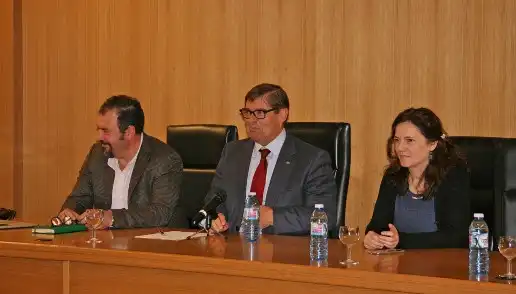
A Coruña, November 17, 2016.- The Dean of the University of Coruña, Julio Abalde, together with the Vice-Dean of Scientific Policy, Research and Transfer, Salvador Naya, and the Vice-Dean of Students,
Participation and University Extension, Margarita Amor, recently met with the university community of the Faculty of Sciences, within the contact list that the governance team university is to be done by all the
UDC centers this year.
I fulfill the objective of these meetings to address the current university interests freely raised by the teaching staff, administration staff and services and the students. In the meeting, issues of management and
academic organization, infrastructure and others related to staff management and administration were raised.
The Dean opened the meeting explaining the current situation of the University and launched a proposal that the entire university community question this course or type of University of Coruña that they want
to be in the future. In this sense, and at the initiative of two teachers, a reflection was set on the teaching workload and the way of teaching that teaching. Abalde encouraged us to analyze from the teaching point of
view whether the structures of grade and master groups are more efficient. “We have to be able to evaluate our degree based on the profile of the student that we want to graduate,” he said, adding that “I would like
this debate to start in a serious way at UDC.” He reiterated the need for the Bologna structure “which is anything but uniform and has to adapt to the conditions of the students” in the figures of the UDC, about 1,400 teachers and about 4,000 Final Degree
Projects given each year, to justify the opening of this debate on teaching. Likewise, based on the master's model, it should be 60 ECTS or 90 ECTS and transfer this debate to the follow-up commission with two
degrees empowered to evaluate the situation of this center. Several professors also expressed the administrative inconveniences of two interuniversity degrees.
The various administrative procedures involved in research projects were one of two issues that raised questions from teachers, as the director explained that in the absence of a specific standard for the economic
management of research, it is necessary to apply the parameters established in the State Xerais Orzamentos Law, which does not contemplate specificities for research but which, if required compliance, conditions
the administrative procedures. Not related to research, we are also trying to use the new InTalent program, to recruit research talent, which is currently open to its first call. Lembrou reiterated that this ambitious
program financed by Inditex aims to attract researchers who develop at UDC an innovation program on the frontier of science, different from the existing one and who can achieve some distinctions from the
European Research Council in the medium term.
Regarding the administrative procedures, we asked the government team for greater fluidity of information between the different services, or acknowledged the lack of the UDC in a catalog of services but noted that
the information was available to everyone through the electronic taboleiro that performs, precisely, that function of general information and transparency. The meeting also discussed the infrastructure deficiencies
of the Faculty of Sciences as it is difficult to find an immediate solution due to the economic deficiencies of the UDC. Asked about the situation of two interim substitute teachers, Abalde assured that work is being
done to guarantee continuity in the structural positions. “We are committed to providing stability in the structural interim positions,” he confirmed.