


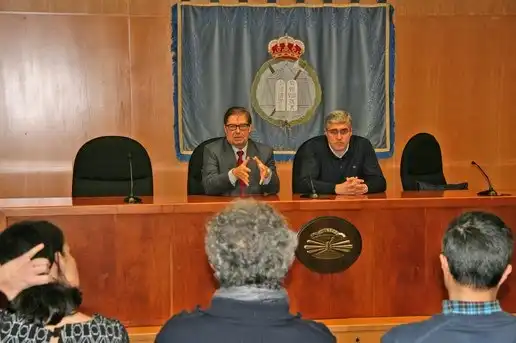
A Coruña, January 20, 2017.- The Rector of the University of Coruña, Julio Abalde, and the General Secretary, Carlos Aymerich, visited the Faculty of Law where they had a meeting with the university community of this center. This visit, which is part of the round of informative contacts that the director is making in all the centers, began with a presentation by the director of two issues that concern him and that, in his opinion, must be addressed this year. The first thing to do is to reflect on the Bologna implementation process once enough years have passed that it is possible to analyze whether the objectives set at the beginning are being achieved and if this is not the case, introduce modifications to the study plans. This challenge is a task that must be faced in each center by teaching and research personnel. Secondly, Abalde pointed out, it is the responsibility of the UDC governing team and what is being worked on. Refer to the specialization of the A Coruña campus, following the steps taken in Ferrol with the Industrial Campus. “We are a generalist university and we therefore have to make it compatible with specialization in any specific line,” he said and advanced that in his opinion there are two clear lines that highlight the University of Coruña, even though it is not specific because they are working on it.
An incentive for specialization and the achievement of greater financing, since the Financing Plan of the Galician University System approved in 2020 appears insufficient. Neste Plano the improvement in financing is related to the improvement in our indicators, but the economic contribution is very reduced; Another way to receive financing is through the achievement of competitive projects, but these income are final and do not pay current expenses. There is a third way, Abalde pointed out, which is to offer differentiated proposals that receive specific financing and through this option will specialize two campuses, such as Industrial de Ferrol, which received income of 1.3 million euros for the years 2016 and 2017. At this point, two professors asked for more detail about the relationship between the university and the company and regretted that participating in European projects involved very complex procedures.
The Rector assured that very intense work is being done to create areas of collaboration with companies in research. This will increase significantly in relation to companies. An example is the UDC-Navantia Joint Research Unit, endowed with 3.2 million euros, which is functioning “very well”. “In fact”, The Rector advanced “want to increase collaboration”. Other companies that are working to establish agreements on research issues are, for example, Emalcsa, or Cluster TIC, Tranvías, R, etc. Work is also being done, Abalde explained, for companies to finance UDC’s own projects, as Santander Bank is doing with Espazo Compartido; LaCaixa provides mobility assistance, and Inditex provides financial support to the students of teaching and the InTalent program.
Furthermore, now, Aymerich explained, companies that collaborate with the University can rely on the Patronage Law, which means that they will be able to reduce their taxes.
Regarding the European H2020 projects, we acknowledge the complexity of their processing. UDC has an office in Brussels and is supported by OTRI to support researchers participating in European projects, but the calls are “so differentiated that specific training is required for each area,” he lamented. In Galicia, in addition, lobbying work is necessary, just like in other communities such as the Basque Country or Catalonia, where the results are limited. However, he pointed out, UDC is set to significantly increase the number of projects presented and their success.
Regarding the accreditation calendar for two training programs, which was one of the professor’s questions, Abalde announced that the universities and ACSUG are going to create a follow-up protocol that will begin next year. This same professor is interested in the impression of the president of the negotiations that the Conference of Professors of Spanish Universities, CRUE, is maintaining with the Ministry of Education on various conflictive issues such as, for example, the new criteria for obtaining teaching accreditation. The sinalou leader had a further dialogue established with the current minister which made it possible that at the CRUE meeting this Wednesday it was agreed that the duration of two pre-Bologna university degrees would remain as they are for four years, with the existing exceptions, and that the new degrees that are now implemented could be three years. Regarding the criteria for accreditation, he commented that work groups are being created to negotiate the indicators so that they are similar or as similar as possible to previous years. Regarding the replacement tax, the Rector indicated that the Ministry of Education is in favor of its suppression but it remains to be known Face’s position
Published by:
Communications Office