


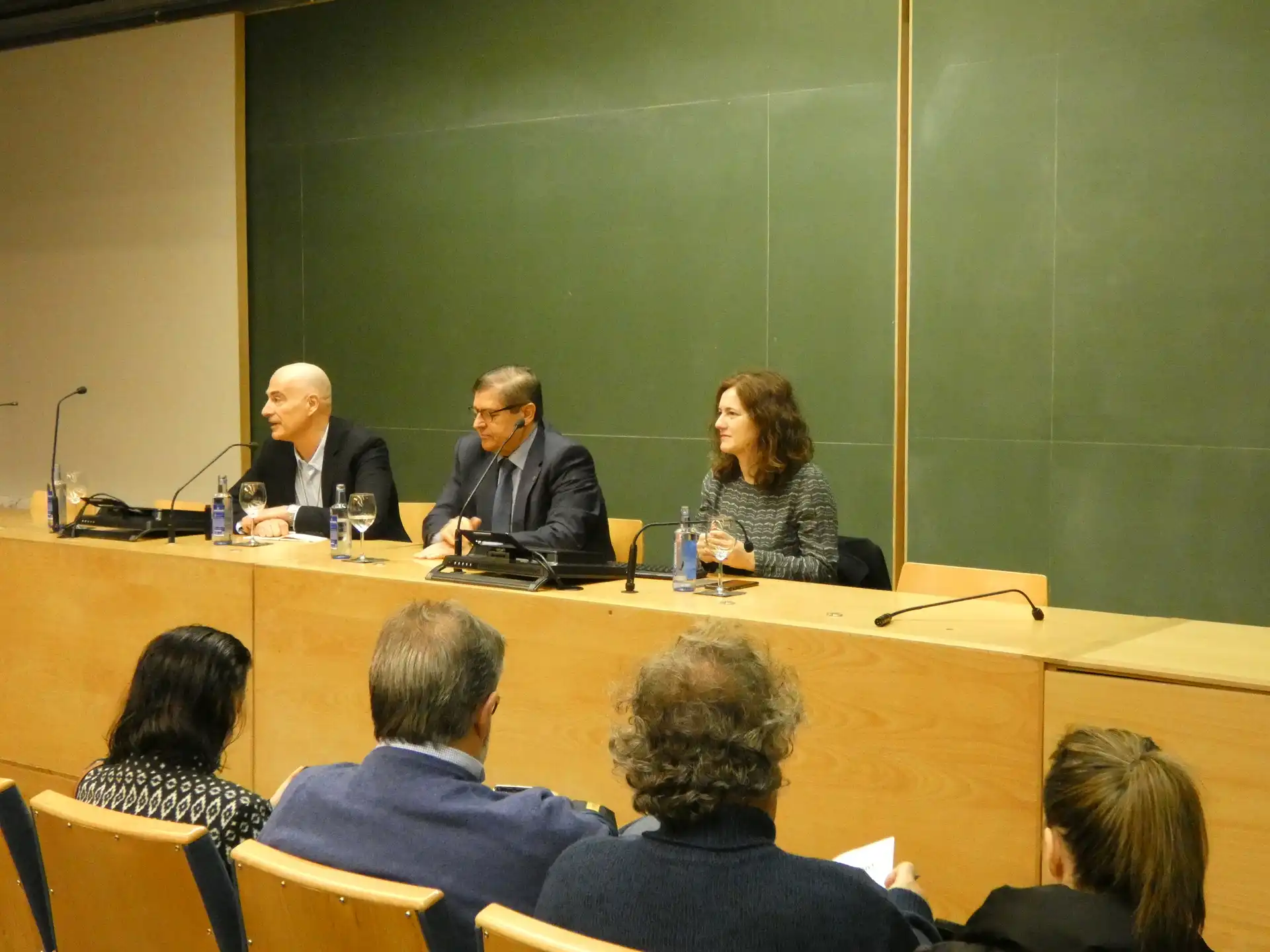
A Coruña, March 4, 2019.- The Rector of the University of A Coruña, Julio Abalde, and the Vice-Rector for Students, Participation and University Extension, Margarita Amor, met on February 21 with the university community of the Higher Technical School of Architecture, as part of the round of contacts that the UDC governing team establishes for every academic year in all centers.
The Rector began the meeting by lamenting the recent passing of the school’s professor Manuel Franco Taboada, as well as appreciating the awarding of the National Architecture Prize to professor Manuel Gallego Jorreto. “It is an honor for our Senate to have an architect with two national prizes,” said Abalde, who then commented on the projects that his team is developing, linked to the objectives set at the beginning of his term. Review and update the academic offer as well as implement new degrees; promote research, especially calls for international projects and increase the internationalization of the university. With regard to research, as a result of greater support for research groups last year, a record number of applications for European projects was achieved as well as funds obtained with more than two million euros. During this time, the UDC’s InTalent research talent recruitment program and the Inditex company were also launched, with the incorporation of very high-level international researchers. Regarding the increase in foreign students, bilateral mobility agreements and teaching itineraries in English have been strengthened to attract more foreign students, managing to increase both the number of exchange students and those who come to complete the entire degree, although in the case of degrees there is the additional difficulty of accessing the university.
All of this has been organized around the specialization campuses, which were established as a result of determining the areas in which the UDC is most representative. The specialization campuses encompass activities developed in these three areas: teaching, research and internationalization. The Industrial Campus, in Ferrol, has been implemented for two years with very good results and now the Sustainability Campus and the Innova Campus have recently been implemented in A Coruña. The Sustainability Campus was created by the strength of the UDC in terms of sustainability from an environmental and territorial organization point of view but also in terms of quality of life and circular economy. The UDC is the only university in northern Spain with a significant offer of degrees in the area of building and construction such as Architecture Studies, Technical Architecture, Civil Engineering, Public Works Engineering, Naval and Oceanic Engineering and Industrial Engineering.
As for Campus Innova, it is related to ICT technologies, with three lines: InnovaTIC, InnovaTech and InnovaHumanitas.
“We are now,” said the Rector, “at the moment of maturation of all the processes.” The new degree proposals are linked to the proposed specializations. The Degree in Fashion Industrial Management, the first in the multilingual Galician University System in English, and the Dual Degree in Electrical Engineering, the first dual of the SUG, on the Industrial Campus; the Degree in Landscape, the first interuniversity in Galicia with the first two courses on the Lugo Campus and the last two at the School of Architecture, linked to the Sustainability Campus; and the Degree in Data Science and Engineering, the Degree in Digital Creation, Animation and Video Games and the Degree in Information and Digital Documentation Management, linked to the Innova Campus. They are transversal degrees, defined Abalde, proposals of an intercenter commission. “We continue to be a generalist university but with certain areas that can be spearheads,” he added.
Work placements
After his presentation, the discussion began, moderated by the director of the School, Fernando Agrasar, with the intervention of a student who considers that the salary of 800 euros per month of the scholarships for recent graduates offered by Feuga and Fuac is “very low”. The Rector considers that more than the amount of the first access to the labor market, the quality of the training that graduates receive is of interest. For Abalde, internships in companies are giving “very good results in terms of job insertion” since before Bologna this possibility did not exist. He also reflected on the consequences that the new regulations that impose the contribution of scholarship holders to Social Security may bring, which he fears may inhibit companies. As the student insisted on this issue, the director of ETSAC pointed out that all the extracurricular internships offered by the School are paid, in addition to insisting on the surveillance they have over them.
One of the teachers raised the possibility of copying the Language Center model for the training and qualification courses that they offer at ETSAC to their students free of charge. The Rector accepted the proposal. “If you propose a project, we would study it,” he said, but specified that the Language Center model requires prior planning and a self-financing structure, so they could not be free courses.
ICT City
Na conversa inquiriron ao reitor polo edificio para as universidades que se está a construír na Cidade da Cultura e polo proxecto denominado Cidade das TIC. Abalde explicou que o edificio da Cidade da Cultura é un proxecto da Xunta para albergar varias entidades de coordinación universitaria como o Consorcio Interuniversitario, a CIUG, Acsug ou Bugalicia.
Regarding the ICT City, the Rector explained that it is a project of the UDC in collaboration with the Galician ICT Cluster that demands greater interaction with the research groups of the University of A Coruña. It is already being done at the UDC research center, CITIC, “but it is insufficient, which is why the Cluster raised this demand with us and we developed a project”. The Rector advanced the participation of ETSAC in the development of the project, if it comes to fruition, since what is proposed is basically “a technological industrial district”. “This is an important project not only for the city of A Coruña but for all of Galicia”, the Rector stressed. In this sector, he added, more than 22,000 people work and it has an annual turnover of more than two billion euros. 45% of the staff and more than half of the turnover are in A Coruña. “The fact that this sector values being close to the UDC is an opportunity for us and we will continue to insist on this project”, he said.
One of the teachers commented that the scale for hiring teachers “is very rigid” and does not value work experience enough. Abalde expressed his understanding but also argued that the evaluated ones require previously established scales to avoid discretionary actions. The meeting also expressed the rigidity when it comes to establishing tribunals with a need for mobility between areas. Abalde agreed to defend transversality “because there are no areas of knowledge in the degrees, they only exist when it comes to the distribution of subjects”. “I cannot agree with you more”, he reiterated, “we have to go for collaboration between areas because the new degrees are transversal”.
Another student lamented the lack of space for group work. “We work with bulky models and have difficulty finding space to meet,” he complained. The Vice-Chancellor for Students said that a space is being prepared for group work by students in the Student Pavilion.
Libraries
One of the librarians present pointed out that the statistics of loans of physical books have been falling in very significant figures for five years. He added that university libraries are experiencing radical changes in their functions and actions, becoming research support and support offices, as well as group work centers for students, knowledge dissemination centers with talks of interest to the academic community, etc. At the UDC, he declared, “now is the time to start that conversation about the future of libraries with the new profiles needed”. The Rector expressed his full support for this initiative, in which he had already wanted to work during his time as Vice-Rector for Degrees. Abalde also explained that the UDC is one of the few universities that has a library in each center, which can favor this project. The Rector also believes that the UDC library staff, very well trained, could be a support service for teachers and students in information processing issues; and he valued its initiatives, an international reference, such as the repository where the TFG, TFM and doctoral theses are. The chancellor considered the proposal presented very interesting.
One of the teachers complained that student participation in the teacher evaluation surveys, Docentia, is very low. “Surveys are fundamental, I want to know what my students think,” he declared. The Rector acknowledged that participation is low, although it varies by school, with some reaching a significant 30% participation and others only 2%. Abalde encouraged all the teachers and the school in general to stimulate student participation. At the meeting, the students demanded several improvement works for the school building and its surroundings, such as the repainting of a pedestrian crossing, municipal competence; and several energy efficiency measures. The Rector explained that the action on the building, which is of great importance, is being carried out in several phases, the first has already been carried out, the second is in the draft and there are still some more that are being negotiated. The Rector added that the annual budget for works for the entire university is only one million euros. He also recalled the budgetary priorities of his government team, which are to maintain the staff and maintain student aid, which exceeds two million euros per year. The UDC spends 300,000 euros each year on aid for bus passes, for example. “It is our decision, so the renovations will have to wait,” he concluded.
Posted by:
UDC Communication Office