


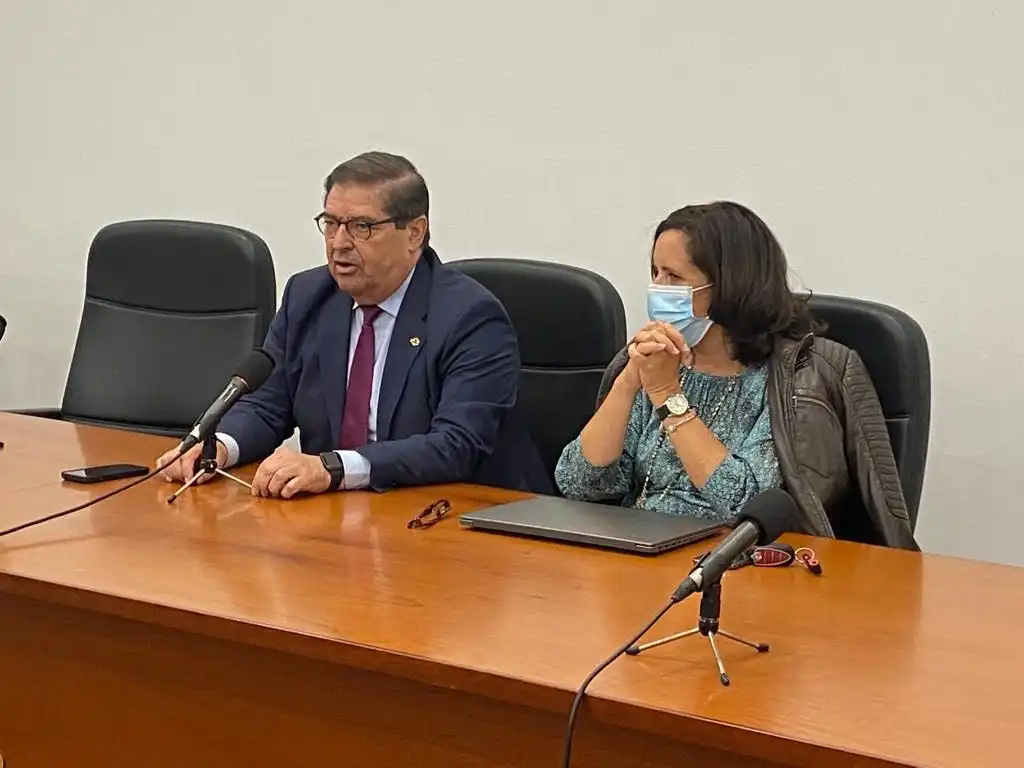
A Coruña, March 27, 2019.- The Rector of the University of A Coruña, Julio Abalde, the Vice-Rector for Students, Participation and University Extension, Margarita Amor, and the Vice-Rector for Teaching Staff and Teaching Planning, Alberto Valderruten, held a meeting on March 11 with the academic community of the Faculty of Health Sciences.
With welcoming remarks from the dean, Adriana Álvarez, the rector delivered his customary address at meetings held in all the university’s centers, outlining the objectives for the start of his term and the projects underway in teaching, research, knowledge transfer, and internationalization. Updating the academic offerings, modifying existing degrees, and introducing new ones to meet the training needs of the productive sectors in the Galician community was the challenge for teaching. In the area of research, priority was given to competing for European project grants, due to the limited or nonexistent support for research in the Autonomous Community and at the national level at that time. EU calls for proposals are complex and challenging, so support for research groups was strengthened. This effort is beginning to bear fruit, as last year the University of A Coruña (UDC) secured record funding of over two million euros for research, in addition to exceeding the number of applications submitted to international calls for proposals. The rector lamented the lack of institutional support from the regional government in Brussels for the university’s efforts, unlike in the Basque Country and Catalonia. Regarding knowledge transfer, Abalde asserted that “the institution must be proactive in seeking collaborative opportunities with businesses.” The most visible result of this relationship between the university and the productive sector is the increase in the number of endowed chairs with companies, from three to eleven. Finally, concerning internationalization, the aim is to intensify student mobility: this year, the University of A Coruña (UDC) is hosting over 650 international students, in addition to attracting students to complete their entire undergraduate, master’s, or doctoral degree here. While this is easier at the higher levels, it is very difficult for undergraduate students due to the university entrance system, which relies on entrance exams. Efforts have also been made to intensify internationalization at the UDC, with an increase in English-language courses and a multilingual degree: the Bachelor’s Degree in Industrial Fashion Management, in addition to the offer of international double degrees, which in the case of degrees are four: Business Administration, Computer Science, Law and English.
All these lines of action, the rector explained, are difficult to manage with the current university structure. Therefore, the university was organized around specialized campuses, which serve as mechanisms for coordination and knowledge sharing among the different structures, linked to specific areas of expertise. An assessment was conducted of the areas in which the University of A Coruña (UDC) has strengths in teaching, research, and knowledge transfer, and the specializations of the Industrial Campus in Ferrol, and in A Coruña, the Sustainability Campus and the Innova Campus were determined. Sustainability is understood as a cross-cutting concept, involving all centers related to construction and building, with a focus on the circular economy, social sustainability, and quality of life. Innova focuses on technological innovation with three lines of action: Innova ICT, Innova Tech, and Innova Humanitas. These campuses have been assigned the new degree programs: Bachelor’s Degrees in Industrial Fashion Management and Landscape Architecture, joint programs with the University of Santiago de Compostela (USC), already implemented this academic year. Next year, the following programs will be offered: Bachelor’s Degree in Information and Digital Documentation Management, Double Degree in Electronic Engineering (the first double degree in the Galician University System), Bachelor’s Degree in Data Science and Engineering, and Bachelor’s Degree in Digital Creation, Animation, and Video Games. The Bachelor’s Degree in Nanoscience and Nanotechnology will also be offered next year. Abalde pointed out that all of this is taking place in a complex economic situation, in which the priority is maintaining staff, both teaching and research staff (PDI) and administrative and service staff (PAS), and providing support to students. The rector presented figures: while in 2010 personnel expenses totaled 77 million euros out of a budget of 139 million euros, in 2019, these same expenses amounted to 96 million euros out of a budget of 129 million euros.
Following the rector’s presentation, the dean explained some of the faculty’s projects, such as the intention to establish a dual degree program with an English university, which has not yet been finalized, and that they are also in contact with universities in the Netherlands and Latin America. Specifically, next month they will meet with rectors from the Dominican Republic interested in collaborating on the Occupational Therapy degree program. One of the professors expressed his complaint about the malfunctioning elevator in the Occupational Therapy building, a problem that, according to the rector, they were aware of and were trying to resolve. The faculty recruitment programs were also discussed among the attendees, who commented on the different pathways to becoming professors. Abalde stated that the only criterion for hiring professors is teaching load, and, together with the Vice-Rector for Faculty, explained the application processes and the required evaluation criteria. The rector lamented the actions of the Xunta in this regard, which calls for an entry program for researchers, not only from the UDC’s own talent recruitment programs such as InTalent, but also Ramón y Cajal or Marie Curie, among others.
Valderruten provided further information on this year’s Public Employment Offer for faculty positions, which will fill the main pool of accredited professors, and that this pace of new positions is expected to continue next year. The dean also requested public signage for the Occupational Therapy degree building, which, according to the rector, is currently being installed. The meeting concluded with a discussion of the new regulations on professional internships, which the Vice-Rector for Students postponed until at least next year, as the state government must develop implementing legislation.
Publicado por:
Oficina de Comunicación de la UDC